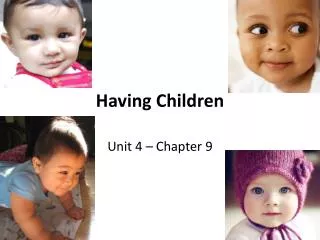
Having Children
Dive into the complexities of modern parenthood in this enlightening discussion. We explore the evolving roles of children within families and society across various cultures and historical contexts. Analyze the shift from viewing families as economic units to psychological ones, and learn about contemporary issues affecting childbearing and rearing. With over 90% of couples intending to have children, we examine why many delay parenting until their 30s and why fertility rates are at an all-time low in Canada. Parenthood is a significant life transition with profound impacts on personal and social dynamics.

Having Children
E N D
Presentation Transcript
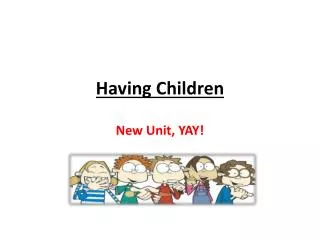
Having Children New Unit, YAY!
Introduction What are we going to learn? • Roles of children in the family and society in various cultural and historical periods. • Factors influencing the transitions of the family from an economic unit to a psychological unit. • Current issues affecting the bearing and rearing of children.
Childbearing • Over 90% of married couples say that they intend to have children. • However, the average age of first time parents have been significantly delayed over the past 20 years. Today, 32% of first time mothers are 30 years old. • Couples are having an average of 1.5 children, this is the lowest fertility rate in Canadian history and it is below the replacement rate. • Why do you think couples are having children later in their lives? • Why are Canadian couples choosing to have 1 or 2 children?
Two Definitions • Life-course approach- views parenthood as the last marker in the transition to adulthood. • Family life-cycle framework- identifies the transition to parenthood as a major, lifelong commitment that should not be taken lightly.
Remember • No matter how you become a parent- through- childbirth, surrogacy, or adoption- parenthood changes your life forever. • One can have ex-spouses and ex jobs, but not ex-children. How does becoming a parent change your life?