Binary Decision Diagrams and Symbolic Model Checking
This document provides an overview of Binary Decision Diagrams (BDDs) and Symbolic Model Checking, highlighting their significance in efficiently representing and manipulating Boolean functions. BDDs serve as canonical forms for Boolean expressions, allowing for simplified algorithms to construct and manipulate them. The applications of BDDs extend to problems expressed as Quantified Boolean Formulas, making them instrumental in verifying large-scale, finite-state systems like hardware designs. Through techniques such as the If-Then-Else operation and variable ordering, we can optimize symbolic manipulation to enhance performance in various analyses.

Binary Decision Diagrams and Symbolic Model Checking
E N D
Presentation Transcript
Binary Decision DiagramsandSymbolic Model Checking Randy Bryant CMU Ed Clarke CMU Ken McMillan Cadence Allen Emerson U Texas http://www.cs.cmu.edu/~bryant
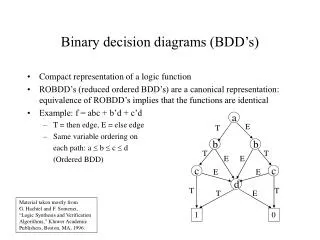
Binary Decision Diagrams • Restricted Form of Branching Program • Graph representation of Boolean function • Canonical form • Simple algorithms to construct & manipulate • Application Niche • Problems expressed as Quantified Boolean Formulas • A lot of interesting problems are in PSPACE • Symbolic Model Checking • Prove properties about large-scale, finite-state system • Successfully used to verify hardware systems
0 1 0,1 1 1 Boolean Function as Language • View n-variable Boolean function as language {0,1}n • Reduced DFA is canonical representation Language DFA Truth Table { 011, 101, 111 }
x1 x1 x1 0 1 x2 x2 x2 x2 0,1 x3 x3 1 x3 1 1 0 1 1 From DFA to OBDD • Canonical representation of Boolean function • Two functions equivalent if and only if graphs isomorphic • Desirable property: simplest form is canonical.
Representing Circuit Functions • Functions • All outputs of 4-bit adder • Functions of data inputs • Shared Representation • Graph with multiple roots • 31 nodes for 4-bit adder • 571 nodes for 64-bit adder • Linear growth
Linear Growth Exponential Growth Effect of Variable Ordering Good Ordering Bad Ordering
Sample Function Classes • General Experience • Many tasks have reasonable OBDD representations • Algorithms remain practical for up to 500,000 node OBDDs • Heuristic ordering methods generally satisfactory Function Class Best Worst Ordering Sensitivity ALU (Add/Sub) linear exponential High Symmetric linear quadratic None Multiplication exponential exponential Low
Symbolic Manipulation with OBDDs • Strategy • Represent data as set of OBDDs • Identical variable orderings • Express solution method as sequence of symbolic operations • Sequence of constructor & query operations • Similar style to on-line algorithm • Implement each operation by OBDD manipulation • Do all the work in the constructor operations • Key Algorithmic Properties • Arguments are OBDDs with identical variable orderings • Result is OBDD with same ordering • Each step polynomial complexity
If-Then-Else Operation • Concept • Basic technique for building OBDD from logic network or formula. Arguments I, T, E • Functions over variables X • Represented as OBDDs Result • OBDD representing composite function • (I T)(I E)
Recursive Calls If-Then-Else Execution Example Argument I Argument T Argument E • Optimizations • Dynamic programming • Early termination rules
With Reduction If-Then-Else Result Generation • Recursive calling structure implicitly defines unreduced BDD • Apply reduction rules bottom-up as return from recursive calls Recursive Calls Without Reduction
Restriction Operation • Concept • Effect of setting function argument xi to constant k (0 or 1). • Also called Cofactor operation (UCB)
a d a b d d c c c Restriction F[b=1] Reduced Result 0 1 1 0 0 1 Restriction Execution Example Argument F
Derived Algebraic Operations • Other operations can be expressed in terms of If-Then-Else If-Then-Else(F, G, 0) And(F, G) If-Then-Else(F, 1, G) Or(F, G)
Generating OBDD from Network Task:Represent output functions of gate network as OBDDs. • A new_var ("a"); • B new_var ("b"); • C new_var ("c"); • T1 And (A, 0, B); • T2 And (B, C); • Out Or (T1, T2); Network Evaluation Resulting Graphs
Functional Composition • Create new function by composing functions F and G. • Useful for composing hierarchical modules.
x 1 x i –1 x i +1 x n Variable Quantification • Eliminate dependency on some argument through quantification • Combine with AND for universal quantification. $ F x F $ i
Finite State System Analysis • Systems Represented as Finite State Machines • Sequential circuits • Communication protocols • Synchronization programs • Analysis Tasks • State reachability • State machine comparison • Temporal logic model checking • Traditional Methods Impractical for Large Machines • Polynomial in number of states • Number of states exponential in number of state variables. • Example: single 32-bit register has 4,294,967,296 states!
Temporal Logic Model Checking • Verify Reactive Systems • Construct state machine representation of reactive system • Nondeterminism expresses range of possible behaviors • “Product” of component state machines • Express desired behavior as formula in temporal logic • Determine whether or not property holds Traffic Light Controller Design Model Checker True False + Counterexample “It is never possible to have a green light for both N-S and E-W.”
Union Intersection Characteristic Functions • Concept • A {0,1}n • Set of bit vectors of length n • Represent set A as Boolean function A of n variables • XA if and only if A(X ) = 1 Set Operations
00 01 o 1 o o 2 2 10 11 n 1 n 2 0 1 Symbolic FSM Representation • Represent set of transitions as function (Old, New) • Yields 1 if can have transition from state Old to state New • Represent as Boolean function • Over variables encoding states Symbolic Representation Nondeterministic FSM o , o encoded 1 2 old state n , n encoded 1 2 new state
old state new state Reachability Analysis • Task • Compute set of states reachable from initial state Q0 • Represent as Boolean function R(S) • Never enumerate states explicitly Given Compute d 0/1 Initial
R1 R1 R1 R0 R2 R2 R0 R0 R0 01 01 01 10 10 00 01 00 00 00 00 10 11 R3 Breadth-First Reachability Analysis • Ri – set of states that can be reached initransitions • Reach fixed point when Rn = Rn+1 • Guaranteed since finite state
R i +1 R i $ old d new R i Iterative Computation • Ri +1 – set of states that can be reachedi +1 transitions • Either in Ri • or single transition away from some element of Ri
Symbolic FSM Analysis Example • K. McMillan, E. Clarke (CMU) J. Schwalbe (Encore Computer) • Encore Gigamax Cache System • Distributed memory multiprocessor • Cache system to improve access time • Complex hardware and synchronization protocol. • Verification • Create “simplified” finite state model of system (109 states!) • Verify properties about set of reachable states • Bug Detected • Sequence of 13 bus events leading to deadlock • With random simulations, would require 2 years to generate failing case. • In real system, would yield MTBF < 1 day.
Global Bus Interface Cluster #2 Abstraction Cluster #3 Abstraction Interface Cluster #1 Bus Mem. Cache Control. Cache Control. Proc. Proc. System Modeling Example • Simplifying Abstractions • Single word cache • Single bit/word • Abstract other clusters • Imprecise timing Gigamax Memory System Arbitrary reads & writes
Commercial Applications of Symbolic Model Checking • Several Commercial Tools • Difficult training and customer support • Most Large Companies Have In-House Versions • IBM, Lucent, Intel, Motorola, SGI, Fujitsu, Siemens, … • Many based on McMillan’s SMV program • Requires Sophistication • Beyond that of mainstream designers
Application Challenge • Cannot Apply Directly to Full Scale Design • Verify smaller subsystems • Verify abstracted versions of full system • Must understand system & tool to do effectively Challenging Systems to Design System Size Model checking Capacity Degree of Concurrency
Real World Issues • Still Too Volatile • Fail by running out of space • Useless once exceed physical memory capacity • Ongoing Research to Improve Memory Performance • Dynamic variable ordering • Exploiting modularity of system model • Partitioned transition relations • Exploiting parallelism • Map onto multiple machines • Difficult program for parallel computation • Dynamic, irregular data structures
Dynamic Variable Reordering • Richard Rudell, Synopsys • Periodically Attempt to Improve Ordering for All BDDs • Part of garbage collection • Move each variable through ordering to find its best location • Has Proved Very Successful • Time consuming but effective • Especially for sequential circuit analysis
Best Choices Dynamic Reordering By Sifting • Choose candidate variable • Try all positions in variable ordering • Repeatedly swap with adjacent variable • Move to best position found • • •
g h i j e f g h b b b b b b b b 1 1 1 1 2 2 2 2 i j f e b b b b 1 1 2 2 Swapping Adjacent Variables • Localized Effect • Add / delete / alter only nodes labeled by swapping variables • Do not change any incoming pointers
Tuning of BDD Packages • Cooperative Effort • Bwolen Yang, in cooperation with researchers from Colorado, Synopsys, CMU, and T.U. Eindhoven • Measure & improve performance of BDDs for symbolic model checking • Methodology • Generated set of benchmark traces • Run 6 different packages on same machine • Compare results and share findings • Cooperative competition
Effect of Optimizations • Compare pre- vs. post-optimized results for 96 runs • 6 different BDD packages • 16 benchmark traces each • Limit each run to maximum of 8 CPU hours and 900 MB • Measure speedup = Told / Tnew or: • New: Failed before but now succeeds • Fail: Fail both times • Bad: Succeeded before, but now fails
Cumulative Speedup Histogram 76 76 80 75 70 61 60 50 # of cases 40 33 30 22 20 13 6 6 10 1 0 >5 >2 >1 >0 bad new >10 >100 failed >0.95 speedups Optimization Results Summary
What’s Good about OBDDs • Powerful Operations • Creating, manipulating, testing • Each step polynomial complexity • Graceful degradation • Generally Stay Small Enough • Especially for digital circuit applications • Given good choice of variable ordering • Weak Competition • No other method comes close in overall strength • Especially with quantification operations
Thoughts on Algorithms Research • Need to be Willing to Attack Intractable Problems • Many real-world problems NP-hard • No approximations for verification • Who Works on These? • Mostly people in application domain • Most work on BDDs in computer-aided design conferences • Not by people with greatest talent in algorithms • No papers in STOC/FOCS/SODA • Probably many ways they could improve things • Fundamental dilemma • Can only make weak formal statements about efficiency • Utility demonstrated empirically