
Calculating Areas of Parallelograms and Trapezoids: Step-by-Step Examples
E N D
Presentation Transcript
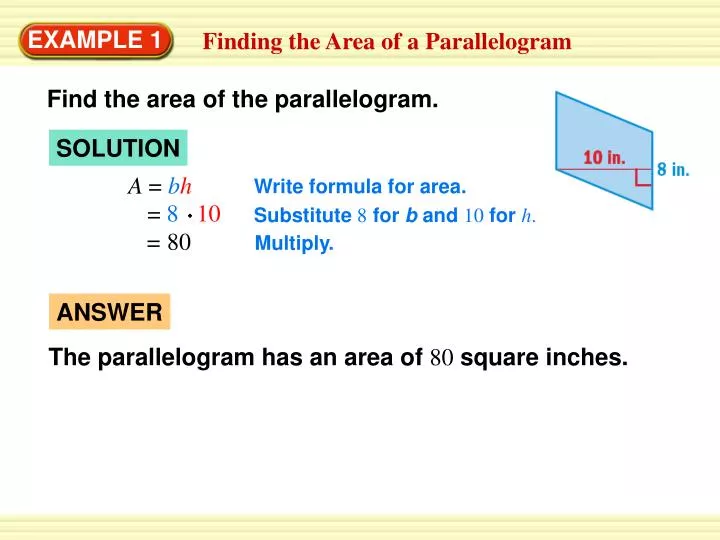
Find the area of the parallelogram. = 810 ANSWER The parallelogram has an area of 80 square inches. EXAMPLE 1 Finding the Area of a Parallelogram SOLUTION A = bh Write formula for area. Substitute 8 for b and 10 for h. =80 Multiply.
1 A = (b1 + b2)h 2 1 (31 + 77)25 A = 2 The front of the roof has an area of 1350 square feet. ANSWER EXAMPLE 2 Finding the Area of a Trapezoid Architecture The Winslow House in River Forest, Illinois, was designed by Frank Lloyd Wright. The front part of the roof is a trapezoid, as shown. What is its area? SOLUTION Write formula for area of a trapezoid. Substitute values for b1, b2 and h. = 1350 Multiply.
= 20 9 ANSWER The parallelogram has an area of 180 m2. for Examples 1 and 2 GUIDED PRACTICE Sketch the quadrilateral and find its area. 1. A parallelogram with a base of 20 meters and a height of 9 meters A = bh Write formula for area. Substitute 20 for band 9 for h. = 180 Multiply.
1 A = (b1 + b2)h 2 1 (14 + 17)6 A = 2 ANSWER The trapezoid has an area of 93 square feet. for Examples 1 and 2 GUIDED PRACTICE 2. A trapezoid with bases of 14 feet and 17 feet and a height of 6 feet Write formula for area of a trapezoid. Substitute values for b1, b2 and h. = 93 Multiply.