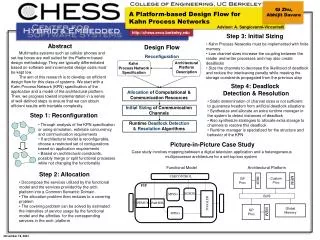
Kahn's Computation Model: A Deep Dive into S-Net Processes and Deterministic Computation
70 likes | 190 Vues
This document explores Kahn's Computation Model, emphasizing the mechanisms of S-net processes. Nodes in this model enqueue items on output channels and read from input channels while performing deterministic computations with conceptually unbounded buffers. Includes detailed examples of processes f, g, and h, illustrating the flow of integers through interconnected nodes. These processes exemplify how Turing machines can function through one-way tapes, providing insight into the foundational theory of computation as applied in networked environments.


Kahn's Computation Model: A Deep Dive into S-Net Processes and Deterministic Computation
E N D
Presentation Transcript
Short Description on Kahn’s Process Underlying Computation Model for S-net
Kahn’s Computation Model • Nodes enqueue items on the output channels • Read from an input channel (block) • Node performs a deterministic computation • Conceptually unbounded buffer
Example integer channel X, Y, Z, T1, T2; Process f(integer in U, V; integer out W); Begin integer I; Logical B = true; Repeat Begin I := if B then wait(U) else wait(V); print(I); send I on W; B = neg(B) End; End;
Example Contd. Process g(integer in U; integer out V, W); Begin integer I; Logical B = true; Repeat Begin I := wait(U); if B then send I on V else send I on W; B = neg(B) End; End;
Example Contd. Process h(integer in U; integer INIT); Begin integer I; send INIT on V; Repeat Begin I := wait(U); send I on V; End; End; f(Y, Z, X) par g(X, T1, T2) par h(T1, Y, 0) par h(T2, Z, 1);
Example Contd. • Underlying theory of computation • A set of Turing machines connected via one- way tapes Z Y f h0 h1 X g T1 T2