Download
1 / 16
160 likes | 266 Vues
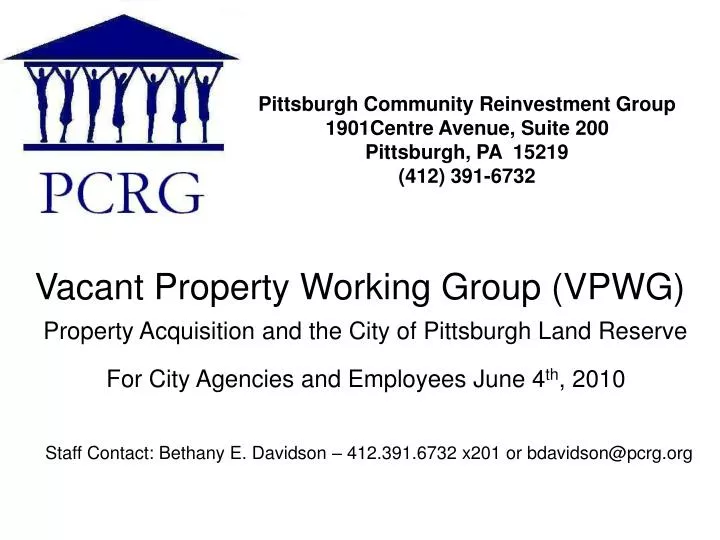
The Vacant Property Working Group (VPWG) in Pittsburgh focuses on addressing the challenges of blight and property abandonment since its formation in 1988. Comprised of community development corporations (CDCs), government agencies, and elected representatives, VPWG seeks to improve land recycling efforts and streamline property acquisition processes. Monthly meetings foster collaboration and discussion about policies, tax collections, and community revitalization initiatives, ultimately aiming to reduce the city's significant number of vacant properties and enhance local neighborhoods.

E N D
Pittsburgh Community Reinvestment Group 1901Centre Avenue, Suite 200 Pittsburgh, PA 15219 (412) 391-6732 Vacant Property Working Group (VPWG) Property Acquisition and the City of Pittsburgh Land Reserve For City Agencies and Employees June 4th, 2010 Staff Contact: Bethany E. Davidson – 412.391.6732 x201 or bdavidson@pcrg.org
Overview • Who / What is VPWG? • Brief History of Land Recycling • State of Vacancy in Pittsburgh • Treasurer’s Sale and Land Reserve Overview • CDCs and Land Recycling • Question and Answer
VPWG • What: Work on issues of blight and abandonment in the City of Pittsburgh • When: Formed in 1988 • Who: Open to any and all in the city • Made up of CDCs and CBOs, representatives of elected offices, government agencies • 2 Neighborhood Co-Chairs • How: Staffed for 12 years through CDBG, housed at PCRG (Pittsburgh Community Reinvestment Group) • Meet monthly as neutral cross-sector table to discuss policy, vet ideas, understand current property issues
Issues • Scalable Land Recycling System • Land Acquisition Processes • Tax Collections • Code Enforcement • Policy [Local, State, Federal] • SideYard Sales/Garden Waiver Program • CARC and GLS Lien Portfolios • Disruptive Properties and Rental Permitting • Demolitions and Greening • Access to Data / Parcel Information
Methods of Acquisition • City of Pittsburgh Sideyard Sales Program • Bank / Real Estate Owned (REO) properties • PCRG Partnerships with local & national lenders • Second Class City Treasurer’s Sale • Intent is tax collection, not foreclosure mechanism • City of Pittsburgh Property Reserve • Non-profit community development organizations • 300 property maximum (234 currently)
Vacancy in the City of Pgh • 112,918 Total Residential Parcels in the City • 15,487 Vacant Residential Parcels in the City (13.7%) • 84,989 Single Family Homes in the City • 4,576 Single Family Homes in the City not receiving mail delivery due to vacancy (5.4%) • Vacant lots and properties are concentrated in several neighborhoods
Land Reserve History • Reserve established by Council Bill 402 of 1998 Enabled creation of a land reserve, process for lien buybacks, and provisions for future lien portfolio sales • City lien portfolio sold in 1996 to Capital Asset Research Corporation (CARC), bought back in 2007 • County Lien portfolio sold at same time – only partially bought back • 3TB – Three Taxing Bodies agreement
Land Reserve Usage Provisions • CDC must: • Have a redevelopment plan in place, including proof of (current or future) ability to finance and complete project • Adhere to designated process and all timelines • Remove properties from reserve in designated time (2 or 5 years) • Formal Request for Time Extension (properties with clear title) • 30 day default notification from City • 1 year restriction on utilizing Reserve if in Default
Eligible 1+ prior Years Tax Delinquent Vacant/Abandoned Ineligible Payment plan Sheriff’s Sale/Foreclosure Bankruptcy Paid in Full Already in Process Private Bidder Side Yard Sale Properties
Other Acquisition Issues • Inclusion of City owned property • Three Taxing Body guidelines • Inclusion of occupied property • Relocation costs • VPWG policy agenda item • Property reserve and for-profit developers • CDC must split profits with City • ‘Flipping’ properties • Developer and financing commitments
Land Reserve Usage Provisions • CDC must: • Have a redevelopment plan in place, including proof of (current or future) ability to finance and complete project • Adhere to designated process and all timelines • Remove properties from reserve in designated time (2 or 5 years) • Formal Request for Time Extension (properties with clear title) • 30 day default notification from City • 1 year restriction on utilizing Reserve if in Default
Application and Selection • Project Feasibility Application • Strategic (not speculative) development plan • Development and financing plan • Due diligence • Community/political support • Partners • Urban Redevelopment Authority • City Finance, Real Estate Department • Pittsburgh Community Reinvestment Group • Allegheny County Dept. of Economic Development
Treasurer’s Sale & Redemption Period • Properties identified for sale • URA approval • No redemption or payment plan • Treasurer’s Sale • Public bids (no clear title) • 90 day Redemption Period • Opportunity for CDC to request revenue properties
Current System Issues • Quantity Limit • Capacity • Resources • Maintenance • Timeline • Complex
Question / Answer Thank You