Download
1 / 1
10 likes | 125 Vues
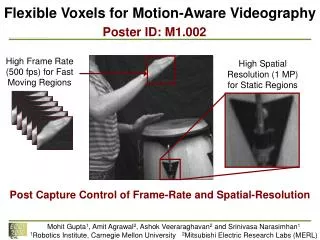
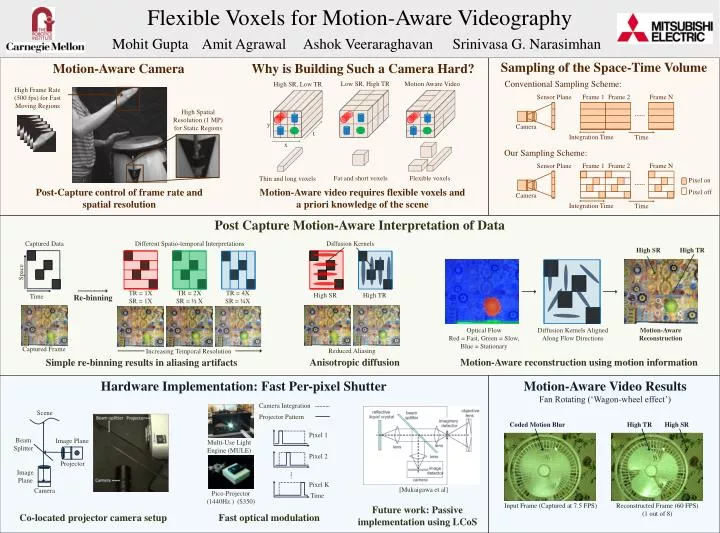
This paper explores innovative techniques in motion-aware videography using flexible voxels to enhance frame rates and spatial resolution. Conventional sampling schemes face challenges in capturing fast-moving regions, emphasizing the need for adaptable solutions. The proposed approach integrates multiple frame rates for diverse regions, leveraging prior scene knowledge to optimize camera performance. Key findings include methods for post-capture frame rate control and reconstruction techniques that minimize aliasing artifacts. Future work focuses on passive implementations and more efficient hardware integration.

E N D
Flexible Voxels for Motion-Aware Videography Mohit Gupta AmitAgrawal Ashok Veeraraghavan Srinivasa G. Narasimhan y t Sampling of the Space-Time Volume Motion-Aware Camera Why is Building Such a Camera Hard? x Conventional Sampling Scheme: High SR, Low TR Low SR, High TR Motion Aware Video High Frame Rate (500 fps) for Fast Moving Regions Sensor Plane Frame 1 Frame 2 Frame N High Spatial Resolution (1 MP) for Static Regions Camera Integration Time Time Our Sampling Scheme: Sensor Plane Frame 1 Frame 2 Frame N Thin and long voxels Fat and short voxels Flexible voxels Post-Capture control of frame rate and spatial resolution Motion-Aware video requires flexible voxels and a priori knowledge of the scene Camera Integration Time Time Post Capture Motion-Aware Interpretation of Data Captured Data Different Spatio-temporal Interpretations Diffusion Kernels High SR High TR Space TR = 1X SR = 1X TR = 2X SR = ½ X TR = 4X SR = ¼X High SR High TR Time Re-binning Optical Flow Red = Fast, Green = Slow, Blue = Stationary Diffusion Kernels Aligned Along Flow Directions Motion-Aware Reconstruction Pixel on Captured Frame Reduced Aliasing Increasing Temporal Resolution Pixel off Anisotropic diffusion Motion-Aware reconstruction using motion information Simple re-binning results in aliasing artifacts Hardware Implementation: Fast Per-pixel Shutter Motion-Aware Video Results Fan Rotating (‘Wagon-wheel effect’) Camera Integration Projector Pattern Scene Coded Motion Blur High TR High SR Pixel 1 Beam Splitter Image Plane Pixel 2 Projector Image Plane Pixel K [Mukaigawa et al] Time Camera Input Frame (Captured at 7.5 FPS) Reconstructed Frame (60 FPS) (1 out of 8) Future work: Passive implementation using LCoS Multi-Use Light Engine (MULE) Co-located projector camera setup Fast optical modulation Pico-Projector (1440Hz.) ($350)