
SlideServe
Menu
Préférences
© SlideServe · v2026

Learning Disabilities
lexi avatar
21 diapositives · 605 Views · Sep 19, 2014

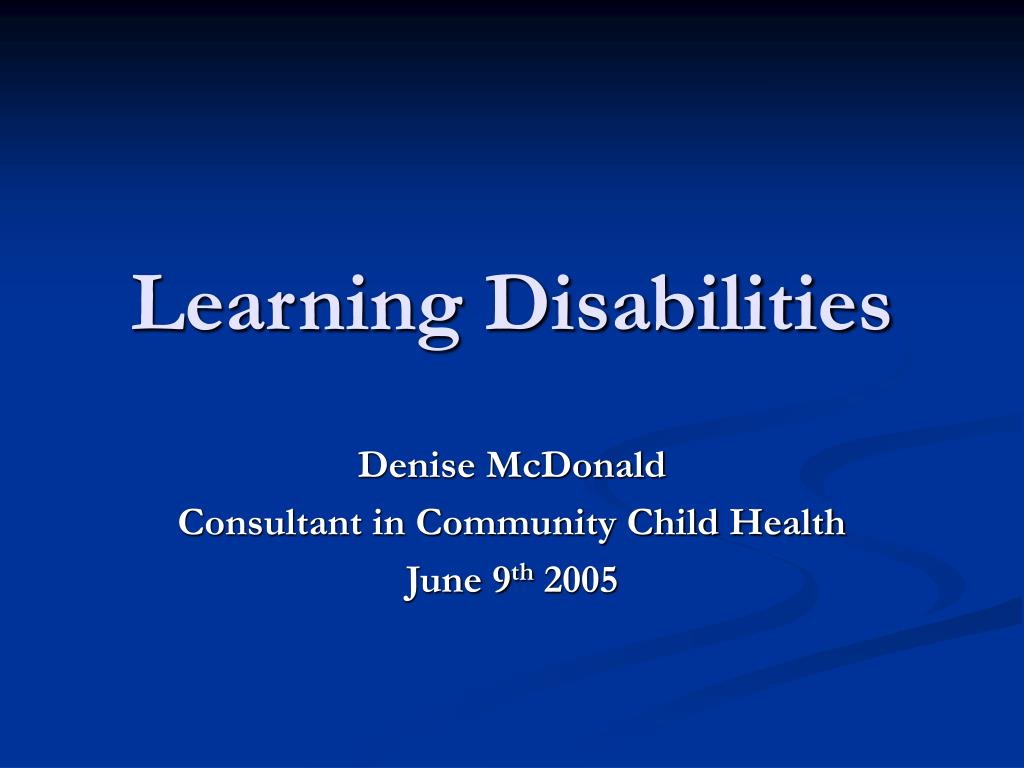
Learning Disabilities. Denise McDonald Consultant in Community Child Health June 9 th 2005. OBJECTIVES. What is learning disability? How common is it? Detection and assessment Medical management Educational management Government policy/resources. Learning disabilities.
Learning Disabilities - slide 1
01 / 21Learning Disabilities
1 / 17

Télécharger la présentation

Learning Disabilities
Une image / un lien ci-dessous est fourni (tel quel) pour télécharger la présentation

Politique de téléchargement : le contenu du site vous est fourni TEL QUEL pour votre information et votre usage personnel ; il ne peut être vendu, concédé sous licence ni partagé sur d’autres sites sans l’accord de son auteur.Le contenu vous est fourni TEL QUEL, pour votre information et votre usage personnel uniquement. Téléchargez la présentation en cliquant sur ce lien. Lors du téléchargement, si vous ne parvenez pas à télécharger une présentation, l’éditeur a peut-être supprimé le fichier de son serveur.Pendant le téléchargement, si vous ne parvenez pas à obtenir une présentation, le fichier a peut-être été supprimé par l’éditeur.

F I N

Plus de contenu associé

Transcription de la présentation
  1. Learning Disabilities Denise McDonald Consultant in Community Child Health June 9th 2005

  2. OBJECTIVES • What is learning disability? • How common is it? • Detection and assessment • Medical management • Educational management • Government policy/resources

  3. Learning disabilities • ….is a general term that refers to a heterogenous group of disorders manifested by significant difficulties in the acquisition and use of listening, speaking, reading, writing or mathematical abilities. • Intrinsic to the individual….presumed to be due to some CNS dysfunction • May be concomitant with, but not the direct result of….other conditions or influences • Hammill 1990

  4. Intelligence quotients (IQ) • ‘Summary IQ’ of <70 denotes a general learning disability • Mild 50-69 • Moderate 35-49 • Severe 20-34 • Profound <20

  5. How common is LD? • Gaussian distribution of intelligence • 95% of population lie within 2 standard deviations of the mean (100) • UK 0.45-0.6% of children have moderate to severe LD

  6. Specific learning disability • US – 15% of children • Applied to academic skills • Could be appropriately applied to disorders of attention and motor planning • Limitation of IQ tests

  7. Detection and Assessment • Cognitive skills rapidly acquired during the first 3 years • Developmental screening programmes • Early intervention programmes

  8. Early milestones • Motor – fine, gross • Vision • Hearing • Communication – verbal, non-verbal • Social

  9. Developmental screening • 6-8 weeks • 6-9months • 18months • Programme of action for children (PAC)

  10. Early detection • Early smiling and reciprocal social interaction • Early motor milestones – ranges of normal • Communication – verbal and non-verbal

  11. Developmental clinic - AMNCH • Referrals from AMOs, PHNs, SLTs, GPs • 95 referrals 2003, 200 in 2004, 270 in 2005 • Predominantly speech and language development concerns

  12. Developmental clinic - AMNCH • Paediatric assessment • Detailed early history • Current developmental abilities • Medical issues • Family history • Social history

  13. Developmental clinic - AMNCH • Schedule of Growing Skills II • General examination • Investigations • Genetic • Metabolic • Endocrine • Brain imaging

  14. Genetics - 1 • Down Syndrome – 1 in 700 • Sex chromosome abnormalities • 2.5/1,000 females, 1.4/1,000 males • XYY, XXY, XXX, XO • Fragile X – • 1 in 1,000 females carriers, 1 in 1,300-3,000 males affected • 2-10% of children with moderate to severe LD without specific dysmorphic features

  15. Genetics - 2 • Other specific syndromes • Rett – MECP2, X chromosome • Williams – ch 7, defective elastin gene • Soto – deletion(s) 5q35 • Smith Magennis – interstitial deletion 17p11.2

  16. Developmental clinic - AMNCH • Schedule of Growing Skills II • General examination • Investigations • Genetic • Metabolic • Endocrine • Brain imaging

  17. Medical management • Part of multidisciplinary team • Referral for multi-d assessment • Medical follow-up • Investigation results • Medical and emotional issues • ‘Gate-keeping’ • Coordination

  18. Educational Management • Appropriate pre-school placement – early intervention programme • Appropriate school placement • Segregation vs inclusion vs integration

  19. Local and National Services • Voluntary organisations • eg, Brothers of Charity • Schools attached – Cheeverstown, Palmerstown • Down Syndrome Ireland • Autism Services – Beechpark

  20. Government Policy • UK White Paper 2001 • Civil rights • Independence • Choice • Inclusion • Irish Disability Bill 2004 • Assessment of need, service statements • Accessibility • Employment

  21. SUMMARY • Learning disability – general, specific • Frequency • Screening and assessment • Medical management • Educational management • Government policy/resources