Download
1 / 14
140 likes | 261 Vues
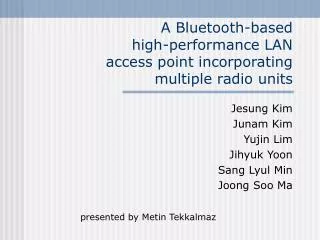
This paper by Jesung Kim, Junam Kim, Yujin Lim, Jihyuk Yoon, Sang Lyul Min, Joong Soo Ma, presented by Metin Tekkalmaz, outlines the aim, design issues, proposed solution, evaluation environment, performance results, and conclusions of a new Bluetooth-based LAN access point. The aim is to increase the number of devices served simultaneously with reasonable quality by utilizing multiple radio units. The proposed design includes using multiple units, operating in Inquiry Scan mode, and directing connections to the least loaded unit. Performance evaluations using an event-driven simulator and traffic generator show promising results, with capacity reaching 128 users at 300 Kbps per user with four radio units. The design is simple yet effective, supported by neat and explanatory evaluations.

E N D
A Bluetooth-basedhigh-performance LANaccess point incorporatingmultiple radio units Jesung Kim Junam Kim Yujin Lim Jihyuk Yoon Sang Lyul Min Joong Soo Ma presented by Metin Tekkalmaz
Outline • Aim • Issues in the Design • Design Proposed • Environment for Evalution • Result of Performance Evaluations • Conclusion
Aim of the Design • Aim is to increase the number of devices that an Access Point can serve simultaneously with a reasonable quality
Issues in the Design • A Bluetooth device serves up to 7 devices simulatenously • Use of multiple radio units is a solution • Interference becomes a problem • To which unit a newcomer will connect?
Design Proposed • Multiple radio units will be used • The Access Point will be in Inquiry Scan mode instead of Inquiry mode • One of the units will be used for initial connection establishment • New connections will be directed to the unit with least number of devices attached
Environment for Performance Evaluation • Event-Driven Simulator • Traffic generator is adapted from Ns • Messages are fed to the L2CAP layer • Two-Phase Round Robin is used as scheduling policy • Parking/Unparking policies • Least recently active slave • One parked for the longest time
Performance Evaluations • Concepts: • Effective throughput • Upload unpark delay • Download unpark delay
Conclusions • Until 4 radio units performance increases rapidly • With 4 radio units 128 users are served with 300 Kbps per user • Simple but nice-working design • Evaluations are neat and explanatory