Download
1 / 88
880 likes | 1.01k Vues
Unravel the meson landscape by examining diquarks, tetraquarks, pentaquarks, and non-quark states, addressing the strange baryons and pentaquark enigmas. The discussion delves into new physics beyond conventional models, focusing on glueballs, hybrids, and the role of charmonium in probing these exotic phenomena. Lattice QCD simulations shed light on the spectrum and decays of these unusual states, offering experimental perspectives to validate or invalidate current theoretical expectations. By exploring the interplay of quark and gluon interactions, this research aims to decipher the complex structure and properties of these unique quantum entities.

E N D
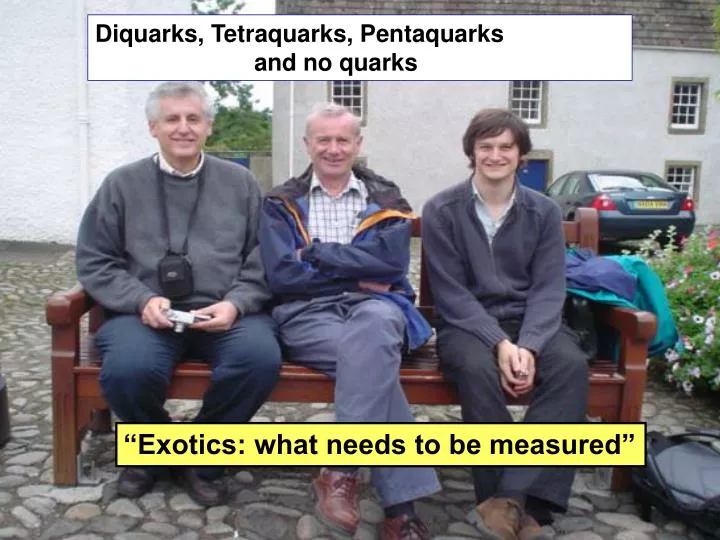
Diquarks, Tetraquarks, Pentaquarks and no quarks “Diquarks,Tetraquarks, Pentaquarks and no quarks” The meson landscape Scalars and Glue in Strong QCD New states beyond Weird baryons: pentaquark problems “Exotics: what needs to be measured” 1
??? e+e- to + X Belle
Claim of Hybrid Charmonium by BELLE Is this the same as X(3940)? Is it hybrid charmonium as claimed? ….probably not, but this might be…….
Y(4260) Three Possibilities Y(4260) = Non resonant S-wave threshold Experimental distinctions….later this talk
Strong QCD: What theory expects Can experiment rule it out? What present and future experiments can test for… Glueballs; hybrids; diquarks; tetraquarks; pentaquarks Especially, but not exclusively, the role of charmonium in achieving these aims
(cc*) 3772 1D: 1- 10023 3686 2S: 1- 3556 9913 2+ 9893 3510 1+ 9860 3415 0+ 9460 3097 1S: 1- Narrow below MM threshold
(cc*) 3772 1D: 1- 10023 3686 2S: 1- 3556 9913 2+ 9893 3510 1+ 9860 3415 0+ 9460 3097 1S: 1- Lattice QCD: Linear: Flux tube…..implies…
e.g. p=1 c.m. Gluonic hybrid mesons Exciting the flux tube Lattice and model agree spectrum; decays in FT not yet lattice
Hybrids later: First – what can be said about glueballs? Glueballs spectrum from Lattice Far away from qq* lowest multiplets… except for 0++
I=1 vector : I=0nn*; ss* + Problem of nn* ss* flavour mixing 1700 1D: 1- 1460 2S: 1- 1320 1270/1525 2+ 1300 1285/1530 1+ 1420 0+ 770 780/1020 1S: 1- Clean below S-wave MM thresholds And no prominent G expected
Glueballs also predicted: Strong QCD spectrum from Lattice Only scalar glueball below 2 GeV Far away from qq* lowest multiplets… except for 0++
I=1 vector : I=0nn*; ss* + Problem of nn* ss* flavour mixing 1700 1D: 1- 1460 2S: 1- 1320 1270/1525 2+ 1300 1285/1530 1+ 1420 1370/1500/1710 0+ 770 780/1020 1S: 1-
I=1 vector : I=0JP =2+ 1+ 0+ 1700 1D: 1- 1460 2S: 1- 13201270/1525 2+ 13001285/1530 1+ 1420 1370/1500/1710 0+ 980 980/600 770 1S: 1-
I=1 vector : I=0JP =2+ 1+ 0+ 1700 1D: 1- 1460 2S: 1- 1270/1525 2+ ? qq* + Glueball 1285/1530 Lattice G =1.6 \pm 1+ 0+ 1370/1500/1710 0+ 980/600 770 1S: 1-
I=1 vector : I=0JP =2+ 1+ 0+ 1700 1D: 1- 1460 2S: 1- 13201270/1525 2+ 13001285/1530 1+ 1420 1370/1500/1710 0+ [qq][q*q*] 980 980/600 770 1S: 1-
I=1 vector : I=0JP =2+ 1+ 0+ 1700 1D: 1- 1460 2S: 1- 1270/1525 2+ ? qq* + Glueball 1285/1530 Lattice G =1.6 \pm 1+ Data do not imply G But given lattice and qq* Does consistent pic emerge? 0+ 1370/1500/1710 0+ 980/600 770 1S: 1- Can data eliminate it; or even make it robust?
Tensor and axial qq* G 2 – 4 GeV ss* 1525 nn* 1270
Scalar Glueball and Mixing • Meson • 1710 • 1500 • 1370 s G n
Scalar Glueball and Mixing • Meson G ss*nn* • 1710 0.39 0.910.15 • 1500 - 0.650.33- 0.70 • 1370 0.69- 0.15 - 0.70 s G n LEAR/WA102 Meson pair decays
Scalar Glueball and Mixinga simple example for expt to rule out • Meson G ss*nn* • 1710 0.39 0.910.15 • 1500 - 0.650.33- 0.70 • 1370 - 0.690.150.70 0- 0- meson decays LEAR/ WA102 FC Kirk s n l Nontrivial correlation with relative masses middle light heavy
Scalar Glueball and Mixing:how to measure flavour state • Meson G ss*nn* • 1710 0.39 0.910.15 • 1500 - 0.650.33- 0.70 • 1370 0.69-0.15 - 0.70 s n
Scalar Glueball and Mixing • Meson G ss*nn* • 1710 0.39 0.910.15 • 1500 - 0.650.33- 0.70 • 1370 0.69-0.15 - 0.70 s n
Coming soon from BES and CLEO-c >1 billion 1000 per meson A flavour filter for 0++ 0-+ 2++ mesons and glueballs Challenge: Turn Lattice QCD Glueball spectrum into physics
OZI rule and flavor tagging in J/ hadronic decays Known ss*/nn* measure ss*/nn* Example of “known” ss*/nn* = 1– or 2+ “ideal” flavour states
OZI rule and flavor tagging in J/ hadronic decays • In J/ hadronic decays, an or Φ signal determinesthe or component, respectively. OZI rule
OZI rule and flavor tagging in J/ hadronic decays Works nicely for 2++ where BOTH are ideal 2++:(1520) 2++:(1270)
OZI rule and flavor tagging in J/ hadronic decays Fails completely for 0^{++}!!!
Leading diagram if 0+ meson contains qq* only
Unusual properties off0(1370), f0(1500) f0(1710) Scalar Puzzle A consistent pattern in these two experiments can establish role of Scalar Glueball \psi \to 0^{++} V Challenge: quantify the predictions
Glueballs and central production G qq* Reality: qq* (also) produced How to separate G and qq*? FC Kirk Schuler 97-00
I=1 vector : I=0JP =2+ 1+ 0+ 1700 1D: 1- 1460 2S: 1- 1270/1525 2+ ? qq* + Glueball 1285/1530 1+ [qq][q*q*] 0+ 1370/1500/1710 0+ 980/600 770 1S: 1-
+ + How can we tell if its this - - + Or this? -
Jaffe model of light scalar mesons Strong QCD attraction of 3*c 3*f qq into 0+ diquark e.g. Maiani et al heavy and light flavours
Inverted flavour multiplets 1- 0+ 1020 ss* 890 su* sd* 780 uu*+dd* 770 uu*- dd* 980 (uu*+dd*)ss* 980 (uu*- dd*)ss* 800 (su*)uu* (sd*)dd* 500 uu*dd* e.g.Tetraquarks v Hybrids: One swallow don’t make a summer. Need the whole flock/multiplet.
New states outside the quark model:D_s(cs*) states that might beDK or tetraquarks Leave discussion to Maiani talk
New states outside the quark model:cc* X(3872) anomalous charmonium
An extra narrow charmonium state Seen in B \to K X(3872)
X(3872) mass compared with DD* thresholds DD* molecule “tetraquark” Mass = neutral threshold to better than 1 in 10,000 cuc*u* S-wave JPC = 1++ isospin maximally broken
Close+Page Tornqvist Swanson
18 cc*1++ 3550; 1++* 3950: DD* (neutral) threshold Psi rho; psi omega P-wave cc* Mass coincidence only happens with Charm, not strange or bottom S-wave 1++ mesons Energy degeneracy will drive this >> model details. Psi rho:psi omega \sim 1 Deviations = dynamics Specific model: Swanson psi D D* uu* vector D* D pi Decays driven by meson-meson wavefunction Production by cc* residue: like psiprime D* D
Molecule or radial 1++ cc*? • Suzuki: cc* with cc*uu* admixture(also FC+ Page) • Further tests: Production in B+ bigger than Bo Test: X \to K+K-\pi>> K0K0\pi CLEOc/BES precision test for 1++ 3550 also
e.g. p=1 c.m. Gluonic hybrid mesons Exciting the flux tube