Organic Chemistry
This guide explores the fundamental structures and functions of vital biochemical compounds, including carbohydrates, proteins, lipids, and nucleic acids. Discover the significance of carbon as the backbone of organic molecules, understanding its ability to form single, double, or triple bonds. Learn about common functional groups in biological molecules and their contributions to molecular functionality. Additionally, delve into key biochemical reactions such as acid-base, oxidation-reduction, hydrolysis, and condensation. 3D molecular modeling is included to aid visual comprehension.

Organic Chemistry
E N D
Presentation Transcript
Organic Chemistry Carbon-based molecules – What we are made of!
Learning Focus • Describe the structure of important biochemical compound – carbohydrates, protein, lipids, and nucleic acids and explain their function within the cells • Identify common functional groups within biological molecules, and explain their contributions to the function of each molecule. • Identify and describe the main types of biochemical reactions: acid-base, oxidation-reduction, hydrolysis, and condensation • Draw 3D molecular models of important biochemical compounds.
Carbon – Central Element of Life • Backbone of all organic molecules • Carbon forms four chemical bonds: Source: http://en.wikipedia.org/wiki/Image:Methane-2D-stereo.svg Source: http://upload.wikimedia.org/wikipedia/commons/5/55/Ch4-structure.png
The Role of Carbon • Backbone of all organic molecules • Can form long chains, ring structures, and complex 3D shapes Source: http://en.wikipedia.org/wiki/Image:Maitotoxin.png
The Role of Carbon • Carbon’s bonds can be single, double or triple Source: http://en.wikipedia.org/wiki/Image:Ethane-2D.png Source: http://en.wikipedia.org/wiki/Image:Ethene_structural.svg Source: http://en.wikipedia.org/wiki/Image:Acetylene-2D.png • Which bond do you think takes more energy to break?
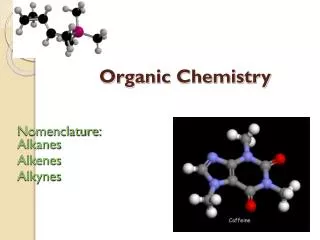
Types of Organic Molecules • Organic compounds with only Hydrogen and Carbon are called Hydrocarbons • Hydrocarbon types: • Alkanes (single bonds) • Alkenes (double bonds) • Alkynes (triple bonds) • Hydrocarbon = non-polar covalent • Other organic compounds are classified by their functional group Acetylene
Functional groups • A group of atoms within an organic compound that give the compound it’s characteristic chemical and physical properties is called a functional group • Functional groups are where much of the bonding i.e. reactions) takes place in biological molecules. • They are attached to the carbonbackbone of organic molecules Source: http://en.wikipedia.org/wiki/File:FG-vs-moiety.png
Skeletal Organic Molecules • Illustrations that “assume” hydrogen Example:
Practice Questions • Identify the circled functional groups
Read pg. 26 on bonding capacity • Pg 27 – Understanding concepts - Practice • Bonding capacity – Tip • One way to remember the bonding capacity of the most 4 common elements in order is through the acronym HONC (pronounced “HONK”). • H = 1, O = 2, N = 3, C = 4