
Understanding Entropy: Disorder, Thermodynamics, and Its Implications
E N D
Presentation Transcript
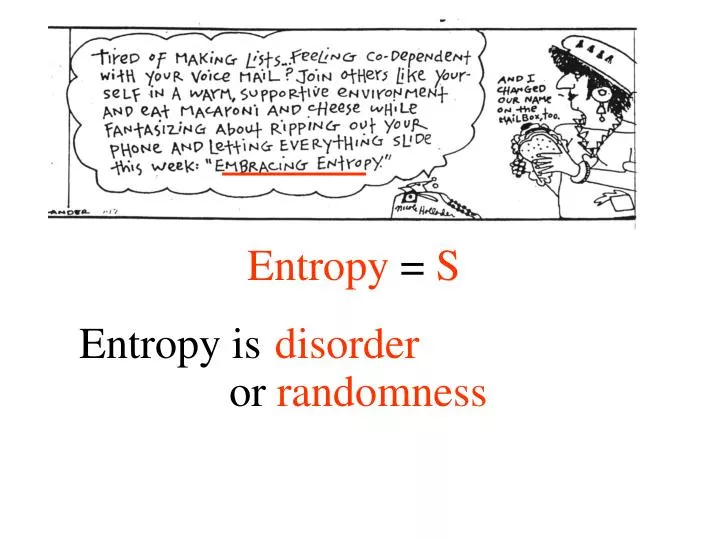
Entropy = S Entropy is disorder or randomness
2nd Law of Thermodynamics Suniverse > 0 for spontaneous processes no external intervention spontaneous = Ssystem Ssurroundings positional disorder energetic disorder
Energetic Disorder P.E. K.E. a) b) random ordered reactants a) endothermic reaction b) exothermic reaction P.E. Hsystem0 < products Hsurroundings 0 > Ssurroundings > 0
Ssurr = - Hsystem (J/K) T Ssurr depends on T heat surroundings high T small effect low T relatively larger effect
Positional Disorder (1/2) (1/2) (1/2) (1/2) (1/2) (1/2) = 1/64 With 1 mole of gas, Not probable
RIP S = k ln W Positional Disorder W = degrees of freedom Boltzman ordered states low probability low S high S disordered states high probability Ssystem Positional disorder Increases with number of possible positions (energy states) Ssolids < Sliquids << Sgases
(J/K) Entropy [heat entering system at given T] convert q to S System 1 Pext = 1.5 atm E = 0 w = -182 J q = +182 J T = 298 K E = 0 System 2 Pext = 0 atm w = 0 q = 0
=- nRT dV V System 3 P1 = 6.0 atm P2 = 1.5 atm V1 = 0.4 L V2 = 1.6 L T1 = 298 K = T2 Pext = Pint + dP reversible process - infinitely slow V2 wr= - Pext dV = - nRT ln (V2/V1) V1
Ssystem = qr T Ssystem System 1 Pext = 1.5 atm w = -182 J q = +182 J S = System 2 Pext = 0 atm w = 0 q = 0 S = System 3 Pext = Pint + dP wr = qr = S = -nRT ln (V2/V1) = - 1120 J + 1120 J 3.77 J/K 3.77 J/K 3.77 J/K Ssurr = - Hsystem T = 1120 J 298 K
3rd Law of Thermodynamics Entropy of a perfect crystalline substance at 0 K = 0
Entropy curve gas liquid solid vaporization S qr T fusion 0 0 Temperature (K)
Entropy S = 0 Entropy is absolute At 0K, S 0 for elements in standard states S is a State Function Sorxn = nSoproducts - nSoreactants S is extensive
Increases in Entropy 1. Melting (fusion) Sliquid > Ssolid 2. Vaporization Sgas >> Sliquid 3. Increasing ngas in a reaction • Heating ST2 > ST1 if T2 > T1. • Dissolution Ssolution > (Ssolvent + Ssolute) ? 6. Molecular complexity number of bonds 7. Atomic complexity e-, protons and neutrons
