Amphibians Part II
This section delves into the movement and regulation systems of amphibians, highlighting the unique adaptations of salamanders, frogs, and caecilians. Salamanders exhibit unspecialized legs and S-shaped movement, while frogs possess specialized legs for jumping and toes for secure attachment. Caecilians, with their snake-like form, utilize distinct feeding mechanisms. The gas exchange process through subcutaneous, buccopharyngeal surfaces, lungs, and gills is examined. Additionally, auditory systems and excretion methods are discussed, emphasizing evolutionary advantages for life on land.

Amphibians Part II
E N D
Presentation Transcript
Amphibians Part II Systems, Movement & Regulation
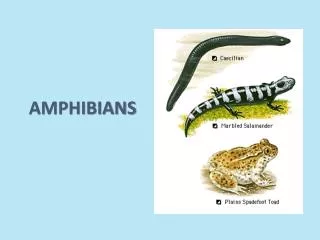
Movement • Salamanders • unspecialized legs, • s-shaped movement • Frogs • legs for jumping • special toes for attachment • Caecilians • snake-like
Feeding • Most adults are carnivorous • Some herbivores/omnivores • Specialized jaws & teeth
Gas Exchange • Subcutaneous • Buccopharyngeal • Lungs • Gills
Auditory Systems • Specialized ears for hearing on land • Produce 2 sounds: • High frequency = mating • Low frequency = territory, protection
Excretion • Ammonia • If live in water • Urea • If live on land • Conserves water
Evolutionary Advantages • Skeleton & muscles for moving on land • Moveable jaw and head • Development of specialized eggs • (resist drying out)