Enhancing Terrain Generation: GPU-Based Realistic Heightfield Synthesis and Editing
310 likes | 422 Vues
This presentation introduces a novel approach for the effective GPU-based synthesis and editing of realistic heightfields. Presented by Giliam J.P. de Carpentier at Delft University of Technology, it addresses the growing demands for higher fidelity graphics in gaming and virtual environments. The talk explores terrain generation techniques, including procedural brushes, local brushing, and erosion simulation, emphasizing the importance of control, feedback, realism, and efficiency. The findings aim to alleviate bottlenecks in terrain design and enhance the workflows of game designers.


Enhancing Terrain Generation: GPU-Based Realistic Heightfield Synthesis and Editing
E N D
Presentation Transcript
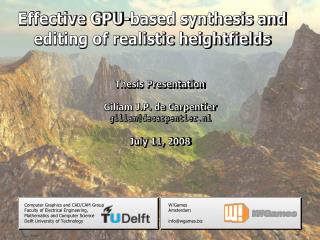
Effective GPU-based synthesis and editing of realistic heightfields Thesis Presentation Giliam J.P. de Carpentier July 11, 2008 giliam@decarpentier.nl Computer Graphics and CAD/CAM Group Faculty of Electrical Engineering, Mathematics and Computer Science Delft University of Technology W!Games Amsterdam info@wgames.biz Effective GPU-based synthesis and editing of realistic heightfields Giliam J.P. de Carpentier
Outline • Introduction • Analysis • Approach • Procedural brushes • Editing on the GPU • Terrain rendering • Demo • Conclusions Effective GPU-based synthesis and editing of realistic heightfields Giliam J.P. de Carpentier
Analysis Both hardware capabilities and gamer’s expectations are constantly growing: • Higher fidelity graphics • More immersive environments and experiences Production requires either: • Larger teams and budgets • More effective tools and more automatization Effective GPU-based synthesis and editing of realistic heightfields Giliam J.P. de Carpentier
Analysis Game content creation: • Indoor environments: • Buildings • Artifacts • Outdoor environments: • Terrain • Vegetation • Actors • … Game content creation: • Indoor environments: • Buildings • Artifacts • Outdoor environments: • Terrain (Heightfields) • Vegetation • Actors • … Effective GPU-based synthesis and editing of realistic heightfields Giliam J.P. de Carpentier
Analysis Heightfield terrain: • 2D specification • 3D geometry • Simple but fast & compact • Importable/exportable as image Effective GPU-based synthesis and editing of realistic heightfields Giliam J.P. de Carpentier
Analysis Three creation categories: • Local brushing • Procedural synthesis • Erosion simulation Effective GPU-based synthesis and editing of realistic heightfields Giliam J.P. de Carpentier
Analysis Three creation categories: • Local brushing • Procedural synthesis • Erosion simulation Applications: • Game editors(e.g. UnrealEd, Sandbox) Pros: • User controllable • Interactive Cons: • Lack of realism Effective GPU-based synthesis and editing of realistic heightfields Giliam J.P. de Carpentier
Analysis Three creation categories: • Local brushing • Procedural synthesis • Erosion simulation Applications: • Terrain generators(e.g. Terragen, World Machine) Pros: • Complex results • Easy to set up Cons: • Lack of local control • Slow Effective GPU-based synthesis and editing of realistic heightfields Giliam J.P. de Carpentier
Analysis Three creation categories: • Local brushing • Procedural synthesis • Erosion simulation Applications: • Terrain generators(e.g. Terragen, World Machine) Pros: • Realistic • Apply to any terrain Cons: • Lack of local control • Very slow Effective GPU-based synthesis and editing of realistic heightfields Giliam J.P. de Carpentier
Analysis Central question: “What are the main bottlenecks in terrain design for current computer gaming applications and how can these bottlenecks be alleviated?” More specifically: • How to improve designers’ workflow? • Which tools and techniques could be provided? • How to reconcile speed and complexity? • How to accomplish this on modern PCs? Effective GPU-based synthesis and editing of realistic heightfields Giliam J.P. de Carpentier
Analysis We need: • Control • Feedback • Realism • Efficiency Effective GPU-based synthesis and editing of realistic heightfields Giliam J.P. de Carpentier
Analysis We’ve got: Control Feedback Realism Efficiency - How do you place or move a realistic mountain in a virtual world? Effective GPU-based synthesis and editing of realistic heightfields Giliam J.P. de Carpentier
Approach Recommended improvements: • Procedural brushes: • Feedback and control of brushes • Realism of procedural techniques • Other suggestions: • Layers and blending • Multi undo Effective GPU-based synthesis and editing of realistic heightfields Giliam J.P. de Carpentier
Approach • Current brushes are simple and procedural techniques are slow for a reason... • Exploit parallelism in current PCs • Multi-core CPUs • Graphics card GPUs Effective GPU-based synthesis and editing of realistic heightfields Giliam J.P. de Carpentier
Approach Implemented testbed for the evaluation of techniques: • Stand-alone editor application • Import/export • Terrain edit system • Procedural brushes • Terrain render system Implemented testbed for the evaluation of techniques: • Stand-alone editor application • Import/export • Terrain edit system • Procedural brushes • Terrain render system Effective GPU-based synthesis and editing of realistic heightfields Giliam J.P. de Carpentier
Procedural brushes Procedural brushes: • Executes procedural algorithm • Limits effect to ‘brushed’ area Effective GPU-based synthesis and editing of realistic heightfields Giliam J.P. de Carpentier
Procedural brushes Procedural algorithms: • Many different algorithms • Deterministic function • Not based on physical models • Designed to visually approximate features • Typically some sort of noisy signal Effective GPU-based synthesis and editing of realistic heightfields Giliam J.P. de Carpentier
Procedural brushes Low Mid Low Mid High + Sum High + + Sum Effective GPU-based synthesis and editing of realistic heightfields Giliam J.P. de Carpentier
Procedural brushes Weights of individual noise signals influence roughness Less “High” More “High” Effective GPU-based synthesis and editing of realistic heightfields Giliam J.P. de Carpentier
Procedural brushes Improving procedural realism: • Output transform • Input transform • Quilez noise • Erosive noise • Directional noise Improving procedural realism: • Output transform • Input transform • Quilez noise • Erosive noise • Directional noise Improving procedural realism: • Output transform • Input transform • Quilez noise • Erosive noise • Directional noise Improving procedural realism: • Output transform • Input transform • Quilez noise • Erosive noise • Directional noise Improving procedural realism: • Output transform • Input transform • Quilez noise • Erosive noise • Directional noise Improving procedural realism: • Output transform • Input transform • Quilez noise • Erosive noise • Directional noise Dynamic octave weights Transform( Proc( x ) ) Proc( Perturb( x ) ) Proc( x ) Proc( x ) Gradient-based input transform Stretched perpendicular to brush direction Stretched at 45˚ rel. to brush direction Stretched along brush direction Effective GPU-based synthesis and editing of realistic heightfields Giliam J.P. de Carpentier
Brushing: Convert mouse stroke to positions on heightfield Create spline from stroke path Create instance locations from spline Apply individual instances Procedural brushes Effective GPU-based synthesis and editing of realistic heightfields Giliam J.P. de Carpentier
Procedural brushes + X Effective GPU-based synthesis and editing of realistic heightfields Giliam J.P. de Carpentier
Editing on the GPU • GPU hardware, standards and interfaces designed for 3D rendering • All other algorithms must be mapped to rendering operations Effective GPU-based synthesis and editing of realistic heightfields Giliam J.P. de Carpentier
Editing on the GPU Mapping heightfield concepts: • Height as color • Heightfields as textures • Split into multiple ‘pages’ • Editing and synthesis algorithms as different pixel shaders Effective GPU-based synthesis and editing of realistic heightfields Giliam J.P. de Carpentier
Editing on the GPU Effective GPU-based synthesis and editing of realistic heightfields Giliam J.P. de Carpentier
Editing on the GPU GPU optimizations: • Don’t update identical sections of RTT output texture • Combine calculations for multiple brush instances in pixel shader • Only apply to affected pages • Divide in affected/unaffected sections • Apply complex procedural pixel shader only to affected sections • Apply ‘copy’ pixel shader tounaffected sections • Neighbor lookups: Split sections into different border cases • Prevent dynamic conditional branching: Use differently compiled pixel shaders Effective GPU-based synthesis and editing of realistic heightfields Giliam J.P. de Carpentier
Terrain rendering Geometry: • Density of triangulation should dependent on distance • Retriangulate on camera move • Need balance between updates and triangle overhead • Solution: Triangulate per ‘tile’ Effective GPU-based synthesis and editing of realistic heightfields Giliam J.P. de Carpentier
Terrain rendering Texturing: • Give each triangle colored detail • Terrain editor concerned with modeling, not withtexturing • Automate texturing with procedural techniques • Dependent on height,slope and randomness Effective GPU-based synthesis and editing of realistic heightfields Giliam J.P. de Carpentier
Demo Effective GPU-based synthesis and editing of realistic heightfields Giliam J.P. de Carpentier
Conclusions • Iterative design requires control, feedback and realism • Developed procedural brushes offer this • Exploring GPU parallelism achieves required fast processing • Proposed novel procedural techniques further improve realism Effective GPU-based synthesis and editing of realistic heightfields Giliam J.P. de Carpentier
Future work • Integrate the stand-alone editor with specific game editor • Develop more common and novel brushes and tools • Develop man-made terrain feature tools Effective GPU-based synthesis and editing of realistic heightfields Giliam J.P. de Carpentier