Gas Laws
This guide provides an overview of the fundamental properties of gases and their laws, including Boyle's Law, Charles' Law, and Lussac's Law. It explains key concepts such as pressure, volume, and temperature, and their interrelationships. For example, Boyle's Law describes how pressure and volume are inversely related when temperature is constant, while Charles' Law shows a direct relationship between volume and temperature at constant pressure. Additionally, the Ideal Gas Law is introduced, unifying these principles for practical applications in various fields.

Gas Laws
E N D
Presentation Transcript
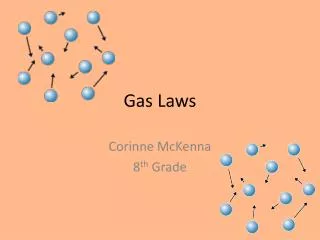
Gases • No definite shape, no definite volume
Properties of GasesPressure • Pressure is defined as the force the gas exerts on a given area of the container in which it is contained • Units- • mm Hg (manometers of mercury) • atm (atmospheres)- air pressure at earth’s sea level • Pa (Pascal) N/m2
Temperature • Measures the kinetic energy of particles • Units- • Kelvin (K) • Celsius (C)
Volume • Volume is the three-dimensional space inside the container holding the gas. • Units- • m3 • L
Boyle’s Law • This law is named for Charles Boyle, who studied the relationship between pressure, p, and volume, V, in the mid-1600s. • Boyle determined that for the same amount of a gas at constant temperature, p * V = constant • This defines an inverse relationship:when one goes up, the other comes down. pressure volume
Application of Boyle’s Law p1 * V1 = p2 * V2 p1 = initial pressure V1 = initial volume p2 = final pressure V2 = final volume With constant temperature and amount of gas, you can use these relationships to predict changes in pressure and volume.
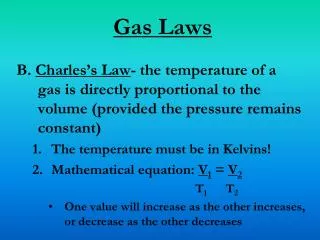
Charles’ Law • This law is named for Jacques Charles, who studied the relationship volume, V, and temperature, T, around the turn of the 19th century. • He determined that for the same amount of a gas at constant pressure, V / T = constant • This defines a direct relationship: an increase in one results in an increase in the other. volume temperature
Application of Charles’ Law V1 / T1 = V2 / T2 V1 = initial volume T1 = initial temperature V2 = final volume T2 = final temperature With constant pressure and amount of gas, you can use these relationships to predict changes in temperature and volume MAIN MENU PREVIOUS NEXT
Lussac’s Law • If a gas's temperature increases then so does its pressure, if the mass and volume of the gas are held constant • P/T = constant • Direct relationship • P1/T1 = P2/ T2
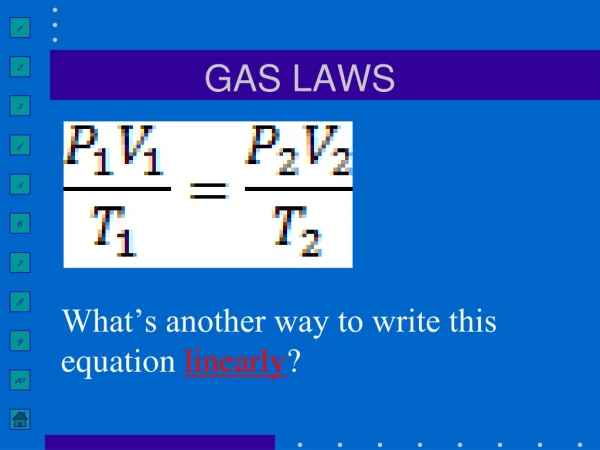
Combined Gas Law • P1V1/ T1 =P2V2/ T2 P1 = initial pressure V1 = initial volume T1 = initial temperature P2 = final pressure V2 = final volume T2 = final temperature
IDEAL GAS LAW • PV = nRT, where • P is pressure (atm or mmHg) • V is volume (m3 or Liters) • n is number of moles • R is the ideal gas constant = • (0.0821 atm x L/Mol x K) • T is temperature (K) • n = m/M, where m is sample mass and M is molar mass