Exploring Polymers: From Natural Sources to Synthetic Innovations
Polymers, the giants of molecules, are macromolecules with enormous molar masses ranging from 10,000 to over 1,000,000 g/mol, typically not visible to the naked eye. Made from smaller chemical units called monomers, the polymerization process transforms them into complex structures. Found extensively in nature, natural polymers like wool and cotton are essential for life. Synthetic polymers, first produced before World War II, have applications in everyday items like plastic bags and tires. This chapter discusses properties, polymer types, and recycling methods, highlighting the impact of polymers on modern life.

Exploring Polymers: From Natural Sources to Synthetic Innovations
E N D
Presentation Transcript
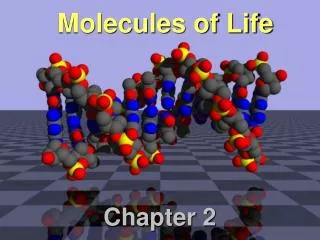
Macromolecules • Compared to other molecules, they are enormous • Molar mass: 10,000–1,000,000+ g/mol • Not visible to naked eye • Polymers: made from smaller pieces • Monomer: small chemical building block • Polymerization: process in which monomers are converted to polymers Chapter 10
Natural Polymers • Found extensively in nature • Life could not exist without polymers • Come in various shapes and sizes • Made of sugars, amino acids, nucleic acids • Examples: wool, silk, cotton, wood, paper Chapter 10
Some Naturally Occurring Polymers Chapter 10
Celluloid • React cellulose with nitric acid • Used for first films and billiard balls • Highly flammable • Used in smokeless gunpowder • No longer in use Chapter 10
Synthetic Polymers • Made from monomer synthesized from fossil fuels • First manufactured shortly before World War II • Synthesized using addition reactions • Add monomer to end of polymer chain • Build very large polymers Chapter 10
Polyethylene • Cheapest and simplest synthetic polymer • Made from CH2=CH2 • Invented shortly before World War II • Has two forms • High-density polyethylene (HDPE) • Low-density polyethylene (LDPE) Chapter 10
Polypropylene • Change a –H to –CH3 • Harder and has higher melting point than polyethylene Chapter 10
Polystyrene • Change a –H to benzene ring • Widely used • Disposable cups • Insulation Chapter 10
Vinyl Polymers • Change a –H to –Cl • Tough thermoplastic • Polyvinyl chloride (PVC) Chapter 10
Teflon • Change all –H to –F • C–F very strong. Resists heat and chemicals • Makes very unreactive polymer Chapter 10
Other Polymers Chapter 10
Practice Problems Chapter 10
Rubber • Pre–World War II • Came from natural sources in S.E. Asia • Japan cut off supply during World War II • Made of isoprene • Chemists learned to make it during World War II Chapter 10
Vulcanization • Link individual polymer strands with S atoms • Makes rubber stronger • Can be used on natural or synthetic rubber • Elastomers: materials that stretch and snap back • Key property of rubber Chapter 10
Synthetic Rubber • Use butadiene • CH2=CH-CH=CH2 • Polychloroprene: substitute –Cl for a –H • Change the properties for other uses • Tend to be resistant to chemicals Chapter 10
Copolymerization • Add two or more different monomers • Uses addition reaction • Allows for modification of polymer’s properties • Styrene–butadiene rubber (SBR) • 75% butadiene/25% styrene mix • Used mainly for tires Chapter 10
Condensation Polymers • Part of the monomer will not be incorporated into the final material • Typically a small molecule like water • Formula of the repeating unit not same as monomer • Used to produce nylon and polyesters Chapter 10
Composite Materials • Use high-strength polymers • Could include glass, graphite, or ceramics • Hold everything together with polymers • Typically thermosetting, condensation polymer • Result is a very strong, lightweight material • Used in cars, sports gear, boats Chapter 10
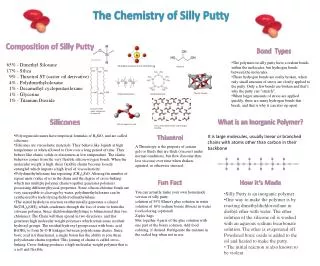
Silicone Polymers • Based on alternating Si and O atoms • Heat stable and resistant to most chemicals • Properties depend on length of polymer • Many uses • Shoe polish, coatings on raincoats, Silly Putty Chapter 10
Properties of Polymers • Crystalline: polymers line up • High tensile strength • Make good synthetic fibers • Amorphous: polymers randomly oriented • Make good elastomers • Some material has both types of polymers mixed together • Flexibility and rigidity Chapter 10
Fiber-Forming Properties • Majority of fabrics made of synthetic polymers • Tend to last longer, easier to care for • Nylon vs. silk • Also may make mixtures • Cotton/polyester blends Chapter 10
Disposal of Plastics • Do not degrade readily • Designed to be durable • Last a long time • Make up 8% by mass of landfills • But make up 21% by volume • Tend to fill up landfills Chapter 10
Recycling • Collect, sort, chop, melt, and then remold plastic • Requires strong community cooperation Chapter 10
Plasticizers • Make plastic more flexible and less brittle • Lower Tg • Tend to be lost as plastic ages • Most common plasticizers today based on phthalic acid Chapter 10
End of Chapter 10 Chapter 10