The Berlin Crisis: A Cold War Showdown and the Berlin Airlift
190 likes | 304 Vues
The Berlin Crisis marked a pivotal moment in the early Cold War, highlighting the tensions between the US and the Soviet Union over Germany's future. Following World War II, the Potsdam Agreement required reparations to the USSR, but American aid through the Marshall Plan bypassed Soviet claims. As Eastern Germany fell under communist control and West Germany emerged, Berlin became divided, leading to the Soviet blockade of the city. In response, the US and Britain launched the Berlin Airlift, executing 278,000 flights to deliver 2.3 million tons of supplies, ultimately ending the blockade on May 11, 1949.


The Berlin Crisis: A Cold War Showdown and the Berlin Airlift
E N D
Presentation Transcript
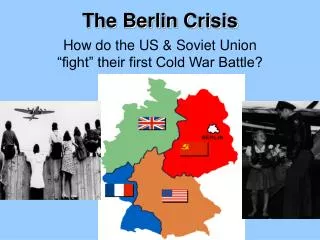
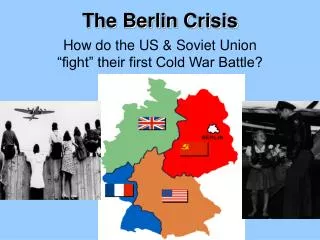
The Berlin Crisis How do the US & Soviet Union “fight” their first Cold War Battle?
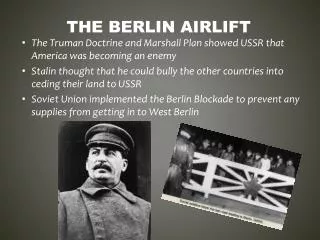
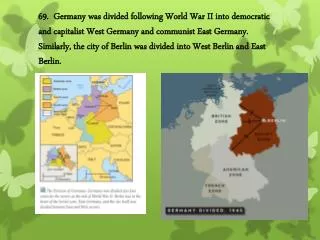
Trouble in Berlin • Says US is violating international law • Potsdam Agreement states Germany must pay reparations to USSR • Marshall Plan giving millions to West German zones, Truman says that money cannot be used to pay to Soviet Union • Installs a communist govt. in Soviet zone, that govt forms the country of East Germany, a Soviet Satellite • Soviet section of Berlin becomes E. Berlin, the E. German capital. No chance of merging zones now. Joseph Stalin • US, Britain & France allow their zones to merge and form a government, creating country of West Germany • Western sections of Berlin merge to form West Berlin • US/GB will have to travel through East Germany to supply City of W. Berlin. Harry Truman
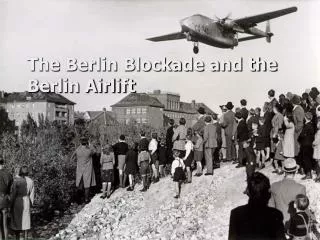
Soviets & East Germans block roads connecting West Germany to West Berlin The Berlin Blockade • No agreement was signed allowing west to use those roads • Soviets hope US will just give up West Berlin Berlin Airlift • US & Britain will airlift supplies into the city, saying they have a legal right to do so (Operation Vittles) • 278K flights were made (June 26-May 11) • 2.3 million tons of food and supplies were delivered • Despite threatening military action, the Soviet Union ends the blockade on May 11, 1949
US Cold War Foreign Policy Berlin Airllift Containment Policy Truman Doctrine Marshall Plan
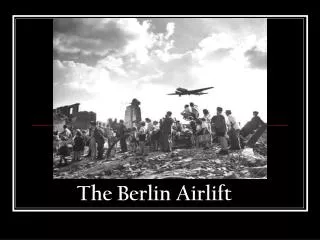
Since roads were blocked into Berlin, US & Britain had to airlift supplies to the city.
A miniature city is used instruct how the airlift will work and locations that will be used.
The limited load capacity of the C-47 aircraft necessitated that the much larger C-54s be added to the airlift as quickly as possible. A single C-54 was capable of carrying as much cargo as four of its older cousins.
Fresh milk being loaded on a C-47. Shipments of whole milk soon were dropped in favor of more weight efficient condensed milk.
One of the first planes to bring in supplies. Food had to be rationed as well. Two-thirds of a pound per day for employed persons and one-half pound for the unemployed.
A C-54 flies over a graveyard and perilously close to some apartments buildings while making its landing approach.
Remains of a Navy C-54 after a crash landing on the night of November 15, 1948.
Miniature parachutes carrying treats for the kids can be seen dropping from a C-54 as it comes in for a landing.
Waiting for supplies. Notice the kids sitting on rubble from WWII