Inverse PCR Methodology for Recovery of Origin Sequences from Self-Ligated Circular DNA
This document outlines the inverse PCR technique utilized for recovering original DNA sequences from blunt-ended fragments generated by HaeIII restriction enzyme. Following dilution and ligation of the fragments under conditions that promote monomeric self-ligation, inverse PCR is performed using specific primers (IvF and IvR). The resulting linear double-stranded product encompasses the original sequences flanking the AB-PCR fragments, allowing for identification of the ligation sites and recovery of the origin sequences through specific primer extension.

Inverse PCR Methodology for Recovery of Origin Sequences from Self-Ligated Circular DNA
E N D
Presentation Transcript
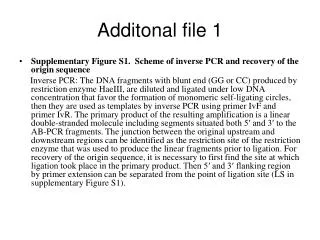
Additonal file 1 • Supplementary Figure S1. Scheme of inverse PCR and recovery of the origin sequence Inverse PCR: The DNA fragments with blunt end (GG or CC) produced by restriction enzyme HaeIII, are diluted and ligated under low DNA concentration that favor the formation of monomeric self-ligating circles, then they are used as templates by inverse PCR using primer IvF and primer IvR. The primary product of the resulting amplification is a linear double-stranded molecule including segments situated both 5′ and 3′ to the AB-PCR fragments. The junction between the original upstream and downstream regions can be identified as the restriction site of the restriction enzyme that was used to produce the linear fragments prior to ligation. For recovery of the origin sequence, it is necessary to first find the site at which ligation took place in the primary product. Then 5′ and 3′ flanking region by primer extension can be separated from the point of ligation site (LS in supplementary Figure S1).
5’Flanking region A box B box body tail 3’Flanking region primer IvR AAT primer IvF GG or CC GG or CC 3-ACCAATCTCGTACCGTGATCG-5 5-GYCAAGGTCRTGGGTTCGAT-3 LS Self-Ligation Real or putative The primary product primer IF B box body tail 3’Flanking region 5’Flanking region A box primer IR primer IvF primer IvR 5’Flanking region A box B box body tail 3' Flanking region The recovery product 5’Flanking region A box B box body tail 3’Flanking region AAT LS primer IvR LS primer IvF LS