Energy: Forms and Changes
Energy is an essential element of our surroundings, manifesting itself in various forms such as heat, chemical, electromagnetic, nuclear, and mechanical. This concept plays a crucial role in daily activities, from hitting a softball to powering homes with electricity. Energy is defined as the ability to do work, and is measured in joules (J). It exists in two primary states: potential and kinetic, describing stored and motion energy respectively. By understanding energy's forms and its conversions, we can comprehend how it drives life, movement, and technology.

Energy: Forms and Changes
E N D
Presentation Transcript
Nature of Energy • Energy is all around you! • You can hear energy as sound. • You can see energy as light. • And you can feel it as wind.
Nature of Energy • You use energy when you: • hit a softball. • lift your book bag. • compress a spring.
Nature of Energy Living organisms need energy for growth and movement.
Nature of Energy • Energy is involved when: • a bird flies. • a bomb explodes. • rain falls from the sky. • electricity flows in a wire.
Nature of Energy • What is energy that it can be involved in so many different activities? • Energy can be defined as the ability to do work. • If an object or organism does work (exerts a force over a distance to move an object) the object or organism uses energy.
Nature of Energy • Because of the direct connection between energy and work, energy is measured in the same unit as work: joules (J). • In addition to using energy to do work, objects gain energy because work is being done on them.
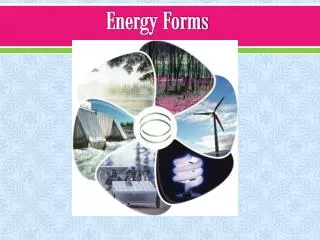
Forms of Energy • The five main forms of energy are: • Heat • Chemical • Electromagnetic • Nuclear • Mechanical
Heat Energy • The internal motion of the atoms is called heat energy, because moving particles produce heat. • Heat energy can be produced by friction. • Heat energy causes changes in temperature and phase of any form of matter.
Chemical Energy • Chemical Energy is required to bond atoms together. • And when bonds are broken, energy is released.
Chemical Energy • Fuel and food are forms of stored chemical energy.
Electromagnetic Energy • Power lines carry electromagnetic energy into your home in the form of electricity. Light is a form of electromagnetic energy. Each color of light (Roy G Bv) represents a different amount of electromagnetic energy. Electromagnetic Energy is also carried by X-rays, radio waves, and laser light.
Nuclear Energy • The nucleus of an atom is the source of nuclear energy. • When the nucleus splits (fission), nuclear energy is released in the form of heat energy and light energy. • Nuclear energy is also released when nuclei collide at high speeds and join (fuse)
Nuclear Energy The sun’s energy is produced from a nuclear fusion reaction in which hydrogen nuclei fuse to form helium nuclei.
Nuclear Energy • Nuclear energy is the most concentrated form of energy. Most of us live within 10 miles of the Surry Nuclear Power , Plant which converts nuclear energy into electromagnetic energy.
Mechanical Energy When work is done to an object, it acquires energy. The energy it acquires is known as mechanical energy. • When you kick a football, you give mechancal energy to the football to make it move.
Mechanical Energy When you throw a balling ball, you give it energy. When that bowling ball hits the pins, some of the energy is transferred to the pins (transfer of momentum).
Energy Conversion • Energy can be changed from one form to another. Changes in the form of energy are called energy conversions. • All forms of energy can be converted into other forms. • The sun’s energy through solar cells can be converted directly into electricity. • Green plants convert the sun’s energy (electromagnetic) into starches and sugars (chemical energy).
Other energy conversions • In an electric motor, electromagnetic energy is converted to mechanical energy. • In a battery, chemical energy is converted into electromagnetic energy. • The mechanical energy of a waterfall is converted to electrical energy in a generator.
Energy Conversions • In an automobile engine, fuel is burned to convert chemical energy into heat energy. The heat energy is then changed into mechanical energy. Chemical Heat Mechanical
States of Energy • The most common energy conversion is the conversion between potential and kinetic energy. • All forms of energy can be in either of two states: • Potential • Kinetic
States of Energy: Kinetic and Potential Energy • Kinetic Energy is the energy of motion. • Potential Energy is stored energy.
Kinetic Energy • The energy of motion is called kinetic energy. • The faster an object moves, the more kinetic energy it has. • The greater the mass of a moving object, the more kinetic energy it has. • Kinetic energy depends on both mass and velocity. K.E. = mass x velocity 2 What has a greater affect of kinetic energy, mass or velocity? Why?
Potential Energy • Potential Energy is stored energy. • Stored chemically in fuel, the nucleus of atom, and in foods. • Or stored because of the work done on it: • Stretching a rubber band. • Winding a watch. • Pulling back on a bow’s arrow. • Lifting a brick high in the air.
Gravitational Potential Energy • A waterfall, a suspension bridge, and a falling snowflake all have gravitational potential energy.
Kinetic-Potential Energy Conversion Roller coasters work because of the energy that is built into the system. Initially, the cars are pulled mechanically up the tallest hill, giving them a great deal of potential energy. From that point, the conversion between potential and kinetic energy powers the cars throughout the entire ride.
Kinetic-Potential Energy Conversions • As a basketball player throws the ball into the air, various energy conversions take place.
The Law of Conservation of Energy • Energy can be neither created nor destroyed by ordinary means. • It can only be converted from one form to another. • If energy seems to disappear, then scientists look for it – leading to many important discoveries. • In 1905, Albert Einstein said that mass and energy can be converted into each other. • He showed that if matter is destroyed, energy is created, and if energy is destroyed mass is created. • E = MC
Vocabulary Words energy mechanical energy heat energy chemical energy electromagnetic energy nuclear energy kinetic energy potential energy gravitational potential energy energy conversion Law of Conservation of Energy