Download
1 / 30
370 likes | 1.01k Vues
This overview focuses on the classification of genetic disorders, which include single-gene disorders (2%), chromosome disorders (<1%), and multifactorial disorders (60%). It outlines types of mutations such as point mutations, deletions, and insertions, as well as common examples of Mendelian inheritance patterns like autosomal dominant traits (e.g., Huntington's disease) and autosomal recessive traits (e.g., cystic fibrosis). The document also includes information on X-linked recessive disorders, such as hemophilia, and describes the implications of various genetic mutations.

E N D
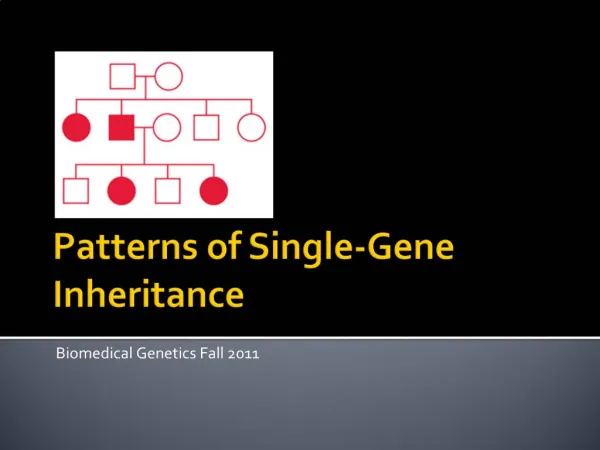
Classification of genetic disorders • Single-gene disorders (2%) • Chromosome disorders (<1%) • Multifactorial disorders (60%)
Gene Mutationbase-pair mutation Nucleotide Substitutions (point mutations) Deletions Insertions
Gene Mutationbase-pair mutation Nucleotide Substitutions (point mutations) silent mutations missense mutations (amino acid substitutions) nonsense mutations (premature stop codons) RNA processing mutations Regulatory mutations
Gene Mutationbase-pair mutation Deletions and Insertions • small number of bases is not a multiple of 3, cause frameshift is a multiple of 3, cause loss or gain of codons • larger gene deletions, inversions, fusions • insertion of L1 or Alu element • dynamic mutations – triplet expansion
Literature Biology, eighth edition, Campbell, Reece Unit three: Genetics Chapter 14: Mendel and the Gene Idea Concept 14.4: Many human traits follow Mendelian patterns of inheritance Pages 276 – 279