Download
1 / 11
110 likes | 216 Vues
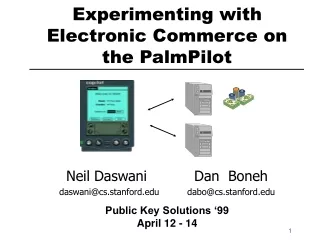
This study by Neil Daswani and Dan Boneh from Stanford University delves into the trade-offs of electronic commerce on PalmPilot versus SmartCards and Desktops. It examines the use of cryptographic primitives like DES, SHA-1, RSA, and ECC-DSA for secure transactions. Focusing on E-Commerce on a PDA, particularly for small payments in applications like Pony Vending Machine, the implementation of PayWord on PalmPilot is detailed. The study emphasizes minimizing cryptographic operations and storage requirements. It concludes that PDAs are suitable for small payments, adaptable commerce protocols like PDA-PayWord, and leverage the best of ECC and RSA.

E N D
Experimenting with Electronic Commerce on the PalmPilot Neil Daswani, Dan Boneh, Stanford University
Trade-offs • Vs. SmartCards • no tamper resistance • no cryptographic accelerators • direct line of communication with user • more processing power • more memory
Trade-offs • Vs. Desktops • less memory • less processing power • portable
Cryptographic Primitives * DES, SHA-1, RSA figures obtained with SSLeay * ECC-DSA figures obtained with Certicom Security Builder Toolkit
E-Commerce on a PDA • Small payments ($5 -> $50) • Target Application: Pony Vending Machine • Pre-pay • Vendor-specific • Where to start? • PayWord (Rivest, Shamir)
PDA-PayWord • PalmPilot implementation of PayWord • Minimize cryptographic operations • Minimize storage requirements
User’s Wallet Bank {Yk, k, d, vid}SECC-DSA(User) Yk Pre-Paid? Yes HCC= {Yk, k, d, exp,vid}SRSA (Bank) Y1 Y0 PDA-PayWord: Withdrawal
PDA-PayWord: Purchase Yk User’s Wallet Yk-i+1 Yk-i Yk-i, i, HCC Yk-i Vendor Y1 Y0
PDA-PayWord: Withdrawal Timings Note: d = 5
PDA-PayWord: Purchase Timings (First time $1.50 buy)
Conclusions / Summary • PDA = portable commerce device w/o tamper resistance • Suitable for small payments • Commerce protocols can be adapted • Example: PDA-PayWord • leverages best of ECC and RSA Acknowledgements: Andrew Toy & Certicom