Reapportionment
Reapportionment is the process of redrawing congressional district lines based on population changes in the U.S. Every 10 years, the Census Bureau assesses population data, influencing the allocation of the 435 House of Representatives seats. This affects representation by determining how many constituents are included in each district. State legislatures take charge of redrawing lines, which can lead to court challenges to ensure fairness and constitutionality. Key considerations include maintaining equal population in districts and avoiding gerrymandering.

Reapportionment
E N D
Presentation Transcript
Reapportionment Government: Libertyville HS
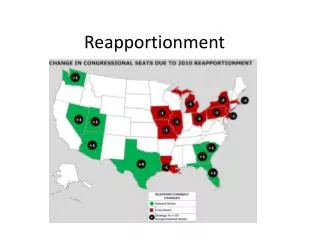
What is Reapportionment? • A method to re-draw congressional district lines to reflect the population changes in America, from state to state • Also called “redistricting” (red – lose population, blue = gain pop)
What is Reapportionment? • Who does it affect? • House of Representatives members ONLY • US Senators NOT affected (why?) • Look at example of unapportioned state w/ 4 districts • Where do you want to live to maximize your representation from congressman: with more or fewer people? 250,000 500,000 5 million 1 million
What is the Process? • Census Bureau counts our population every 10 years to determine where people live • Census Bureau divides the total population of the US by 435 (why?) • This determines the number of Americans per district • Census Bureau then tells each state how many congressional seats it has
Effects of Reapportionment Reapportionment effect, 2010 Reapportionment effect, 2000
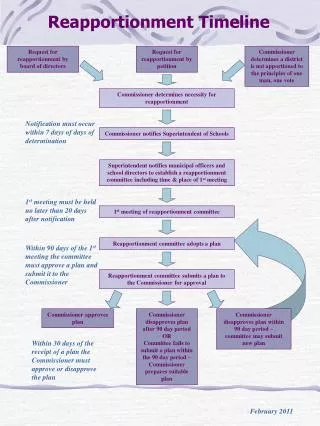
What is the Process? • Each state legislature redraws the district lines • Congress • State Legislature • New lines reflect addition / loss of seats • Court challenges follow to assure constitutionality and fairness of map • Challenges can be brought in state or federal courts • Will end up in USSC
What can be Taken into Consideration? • USSC has decided many cases to determine what can be considered in reapportionment • Same # of people must be in each district (“one man, one vote”): Wesberyv. Sanders • Keep communities together! (AVOID GERRYMANDERING) • Race / ethnicity of a pop. IS NOT allowed to be considered… • …unless a compelling state interest is shown • “Past discrimination” is not a compelling state interest • Showing present discrimination would be enough (Shaw v. Reno)
What can be Taken into Consideration? • Political preference of a population can be considered when re-districting (Latin Voters v. Perry)
Illinois Congressional Map Illinois’ 4th Congressional District