STABILITY IN HIGH-POWERED SOUNDING ROCKETS
110 likes | 239 Vues
This project focuses on the safe separation and deployment of robotics payloads from high-powered sounding rockets. Key objectives include maintaining payload integrity during separation, ensuring a safe landing velocity of 17 ft/s, and achieving proper orientation during ground landing. We implemented a spring-damper system and optimized parachute deployment to mitigate impulse effects. Our work also involves predicting combustion instabilities through regression rate analysis and using MATLAB for data analysis and output visualization. Further developments are anticipated.


STABILITY IN HIGH-POWERED SOUNDING ROCKETS
E N D
Presentation Transcript
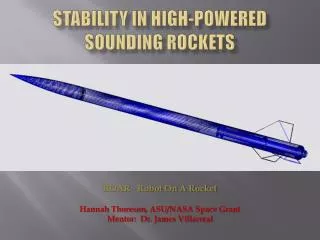
STABILITY IN HIGH-POWEREDSOUNDING ROCKETS ROAR - Robot On A Rocket Hannah Thoreson, ASU/NASA Space Grant Mentor: Dr. James Villarreal
Payload Separation and Deployment • OBJECTIVES: Ensure the integrity of the payload during separation from the launch vehicle and deployment of the robotics component of the project. Bring payload in for landing, deployment, and recovery at a velocity that guarantees the safety of bystanders.
Specifications • Payload should be able to withstand the force of separation • 17 ft/s landing velocity • Proper orientation of robotics payload upon ground landing
Optimization of Impulse Mitigation Plans • Spring-damper dashpot system • Matlab program to calculate and plot oscillations from impulse of parachute deployment • User inputs values for the mass of the combined payload and housing cabinet, the spring constant, and the damping constant
Design Outcomes, Pt. I • Use of a “slider” to slow the speed of parachute deployment
Design Outcomes, Pt. II • Five parachutes, sized to bring craft in at safe landing velocity of 17 fps • “No right side” robot to avoid issues with uncertain landing orientation
Regression Rate Analysis • New project begun in late March with graduate students • Will attempt to predict where combustion instabilities from pressure fluctuations inside the rocket will occur • Without prediction, there will never be resolution
Experimental Set-Up The paoad, in expanded form after leaving te rocket casing.
The Fourier Transform fs = 960 % Sample frequency [data fs] = csvread('data.csv'); % Reads in data from CSV file t = linspace(0,length(data)/fs,length(data)); % Time plot(t,data) xlabel('Time (seconds)') ylabel('Pressure Amplitude') title('Time Domain Plot of Pressure') y = fft(data); % FFT of the data f_Nyquist = fs/2; % Nyquist frequency [y_max index] = max(y); % Principle frequency f = (0:t-1)*(fs/t); % Frequency range plot(x,y) xlabel('Frequency (Hz)') ylabel('Pressure') title('FFT Output')