Direct objects
This guide explains the concepts of direct and indirect objects in sentence structure, emphasizing their roles following action verbs. Direct objects answer the questions "what?" or "whom?" after the verb and are essential for sentence completion. Indirect objects clarify to or for whom the action is performed, situated between the action verb and direct object in a sentence. Through examples like "Rachel bought a cat" and "Ross got Meow-Meow a treat," readers will learn how to identify and diagram these objects in various sentences.

Direct objects
E N D
Presentation Transcript
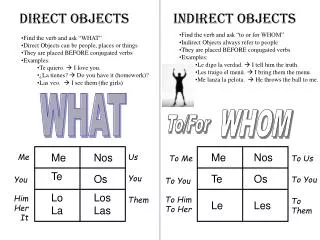
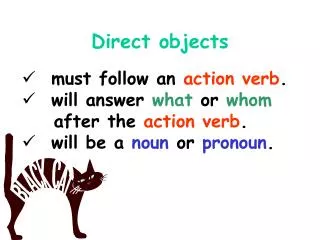
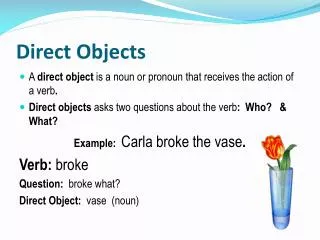
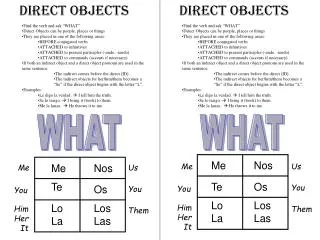
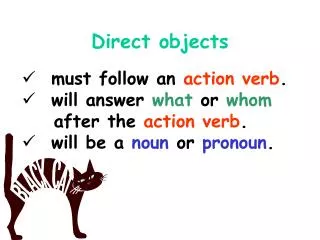
Direct objects • must follow an action verb. • will answer what or whom after the actionverb. • will be a noun or pronoun.
An action verb may also have an indirect object. • There must be a direct object answering what or whom. • The indirect object will answer to or forwhom or what.
will always follow an action verb. will always have a direct object. will come before the direct object. will come after the action verb. will answer to or for whom or what. Indirect Objects
Direct 0bjects bought a cat. Rachel Rachel bought what? cat Bought what? Rachel bought cat
Rachel Bought Tamara a cat. Rachel bought what? cat For whom? RachelboughtcatTamara
Homework, page 301, Exercise 1 • Some sentences will have only direct objects. • Some sentence will have both direct objects and indirect objects. • Diagram each sentence.
Direct Objects • Must follow an action verb. • Answers the question for what or whom. . Mother bought a new bed for kitty.
Indirect Objects • Must have a direct object in the sentence. • Will occur after the action verb. • Will occur before the direct object. • Will answer the question to or forwhom or what.
Diagramming direct and indirect objects Ross got a treat for Meow-Meow. Ross got treat Ross got Meow-Meow a treat. Ross got treat for whom? Meow-Meow
More on Direct Objects • The Tongue Untied Quiz 1 • The Tongue Untied Quiz 2 • Direct Object Sentence Diagraming • Compound direct objects • Indirect object • Compound indirect objects • Direct and Indirect Objects