DIFFERENCES BETWEEN THE ACTIVE AND THE PASSIVE VOICE
80 likes | 209 Vues
This guide explores the fundamental differences between active and passive voice in English grammar. It highlights the situations where passive voice is preferred, such as when the doer is unknown, obvious, or when emphasizing the doer. Detailed examples demonstrate the use of passive voice across various tenses and modal auxiliaries. By understanding when and how to use both forms, learners can enhance their writing clarity and effectiveness.


DIFFERENCES BETWEEN THE ACTIVE AND THE PASSIVE VOICE
E N D
Presentation Transcript
DIFFERENCES BETWEEN THE ACTIVE AND THE PASSIVE VOICE M.A. Aramburu Núñez IES de Sanxenxo
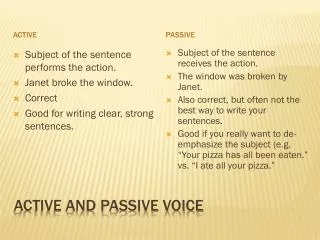
Differences in the use We prefer the passive voice when: • We don’t know or it is not important who the “doer” is: The house was sold yesterday • The “doer” is obvious: The thief was finally arrested. (Obviously by the police) • We want to put special emphasis on the “doer” or put the new information at the end ( in this case we use the by-phrase) : The race was organised by Sir Arnold Lunn M.A. Aramburu Núñez IES de Sanxenxo
Diferenzas no uso Preferimos usar a voz pasiva cando: • Non sabemos ou non importa quen realizou a acción: A casa vendeuse onte. • É obvio quen realizou a acción: Por fin detiveron ao ladrón. (Obviamente foi a policía) • Queremos dar énfase especial a quen o fixo ou poñemos a información nova ao final para destacala ( neste caso usamos by+axente) : A carreira foi organizada por SirArnoldLunn M.A. Aramburu Núñez IES de Sanxenxo
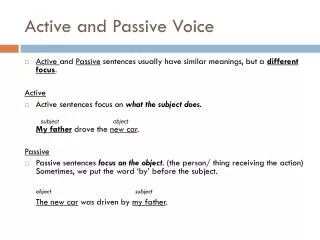
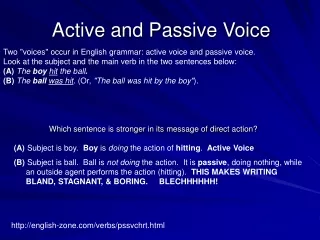
Differences in the form Active voice: Subject verb object + + They push large stones across the ice Passive voice: Subject verb + + to be Large stones are pushed across the ice M.A. Aramburu Núñez IES de Sanxenxo
All the tenses in the passive voice • The Present Simple: • The Present Continuous: am is are 3rd form Curling isplayed on ice + am is are being 3rd form Curling isbeingplayed on ice + + M.A. Aramburu Núñez IES de Sanxenxo
All the tenses in the passive voice • The Present Perfect: • The Past Perfect: have has been 3rd form Curling hasbeenplayed for centuries + + had been 3rd form Curling hadbeenplayed before + + M.A. Aramburu Núñez IES de Sanxenxo
All the tenses in the passive voice • The Past Simple: • The Past Continuous: was were 3rd form Curling wasplayed in the 16th century for the first time. + was were being 3rd form Curling wasbeingplayed when it started to snow. + + M.A. Aramburu Núñez IES de Sanxenxo
All the tenses in the passive voice • With Modal Auxiliaries: • With going to: will would can must … be 3rd form Curling will beplayed in the future. + + is/ are going to be 3rd form Curling is going to beplayed next week. + + M.A. Aramburu Núñez IES de Sanxenxo