
SlideServe
Menu
Préférences
© SlideServe · v2026

Eco-Friendly Tips to Protect Water Quality

lisbet avatar
14 diapositives · 259 Views · Jul 17, 2014

Learn eco-friendly ways to protect water quality in your area! Avoid fertilizer runoff, mulch leaves and grass clippings, and more. Take action now!
Eco-Friendly Tips to Protect Water Quality - slide 1
01 / 14Eco-Friendly Tips to Protect Water Quality
1 / 17

Télécharger la présentation

Eco-Friendly Tips to Protect Water Quality
Une image / un lien ci-dessous est fourni (tel quel) pour télécharger la présentation

Politique de téléchargement : le contenu du site vous est fourni TEL QUEL pour votre information et votre usage personnel ; il ne peut être vendu, concédé sous licence ni partagé sur d’autres sites sans l’accord de son auteur.Le contenu vous est fourni TEL QUEL, pour votre information et votre usage personnel uniquement. Téléchargez la présentation en cliquant sur ce lien. Lors du téléchargement, si vous ne parvenez pas à télécharger une présentation, l’éditeur a peut-être supprimé le fichier de son serveur.Pendant le téléchargement, si vous ne parvenez pas à obtenir une présentation, le fichier a peut-être été supprimé par l’éditeur.

F I N

Plus de contenu associé

Transcription de la présentation
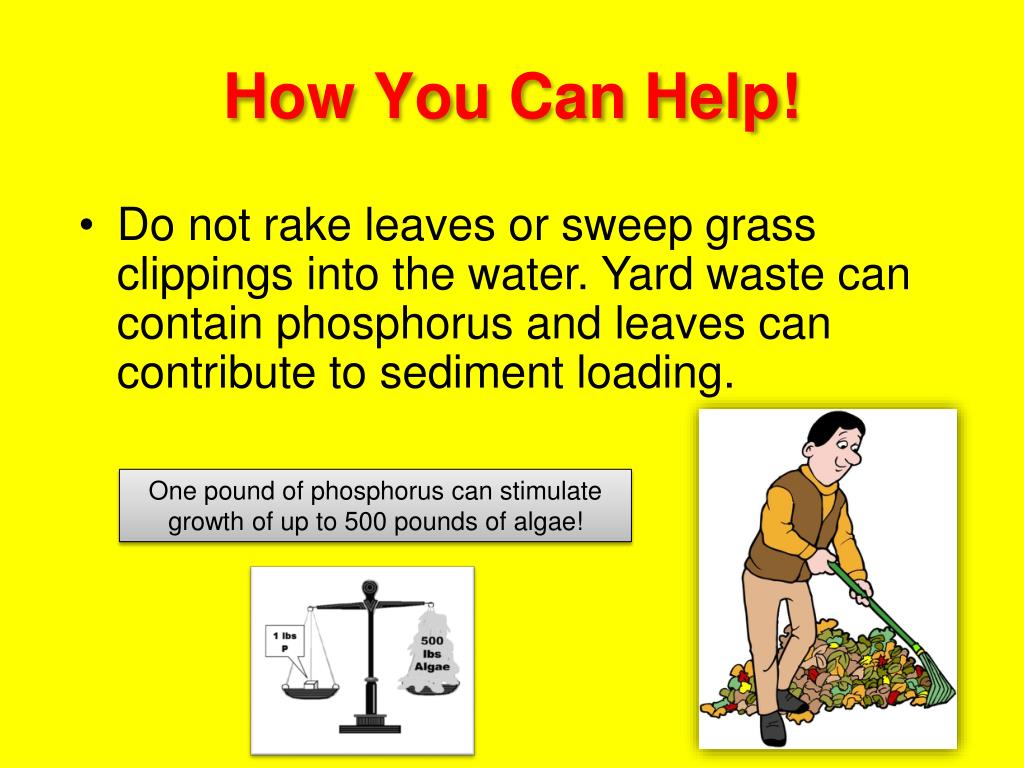
  1. How You Can Help! • Do not rake leaves or sweep grass clippings into the water. Yard waste can contain phosphorus and leaves can contribute to sediment loading. One pound of phosphorus can stimulate growth of up to 500 pounds of algae!

  2. How You Can Help! • Avoid applying fertilizer to ground that is frozen. It will only be washed away. • Do not apply fertilizer within 10 feet of the water's edge. • Do not apply fertilizer before a rainfall.

  3. How You Can Help! • Use ZERO phosphorous fertilizer • Use a core aerator to punch holes in soil before you fertilize. It will reduce runoff and improve turf quality. • Do not apply fertilizer within 10 feet of the water's edge.

  4. How You Can Help! • Take lawn soil samples at least every 3 years in order to apply the correct balance of nutrients • A healthy well established lawn or ditch is the very first line of defense to protect the lake.

  5. How You Can Help! • If you wash your car or boat, wash it on the lawn. • Many soaps and detergents can contain phosphorus. One pound of phosphorus can stimulate growth of up to 500 pounds of algae!

  6. How You Can Help! • If you or a contractor disturb more than 1 acre of ground the law requires you to reseed or take other action to eliminate bare ground erosion.

  7. How You Can Help! • Inspect down spouts or other suspicious connections to a sewer. Storm water running to the treatment plant is a contributing factor to raw sewage being released into the Watershed.

  8. How You Can Help! • If you have a ditch that you maintain try to restore it to the maximum distance (to the easement) and don't mow until August to promote wildlife.

  9. How You Can Help! • Mulch or Compost your grass clippings • Mulching your grass reduces the need for fertilizer because, as the grass clippings break down, nutrients are released into your lawn. And, less fertilizer on your lawn means less fertilizer in the water. • Keep your grass clippings off of hard surfaces (sidewalks, driveways, streets) from which they can be washed away, ultimately ending up in our Lake.

  10. How You Can Help! • Mulch or compost your leaves • Mulch or compost the leaves in your yard as soon as they fall and as often as possible. This minimizes the chance that they will reach our waters. • Regularly clean leaves from your gutters so they can’t be washed away with the rain. • Mulching leaves, like grass, adds nutrients to your lawn, reducing the need for fertilizer.

  11. How You Can Help! • Inspect down spouts or other suspicious connections to a sewer. Storm water running to the treatment plant is a contributing factor to raw sewage being released into the Watershed.

  12. How You Can Help! • Properly dispose of household hazardous waste • Do not pour old gasoline onto the street or wash paint brushes at the end of your driveway. Where do these pollutants end up? In our lakes and wetlands! • Properly dispose of household hazardous wastes. Whether gasoline, paint, pesticides, antifreeze, motor oil, or the like, dispose of them at your county waste site. Their effect on our waters can be devastating!

  13. How You Can Help! • Use ZERO phosphorous fertilizer • Established lawns do not need additional phosphorous and the unused fertilizer can be washed off lawns and enter the lake. So, choose a fertilizer that has zero as the middle number. One pound of phosphorus can stimulate growth of up to 500 pounds of algae!

  14. How You Can Help! • Contact your legislators regarding your concerns • Join the Lake Improvement Association • Make a donation or tax-deductible donation • Report potential water quality threats • Vote for legislative initiatives that will help restore Grand Lake Saint Marys