Understanding Angle Relationships: Finding Missing Measures and Complementary Angles
This educational resource explores the relationships between angles, including complementary and vertical angles. It provides step-by-step examples of finding missing angle measures, emphasizing the use of fundamental properties like vertical angles, supplementary angles, and complementary angles. Students will learn how to apply angle relationships in various scenarios, helping them bolster their geometry skills. Practice problems are included to reinforce understanding and application of angle relationships in real-world contexts.

Understanding Angle Relationships: Finding Missing Measures and Complementary Angles
E N D
Presentation Transcript
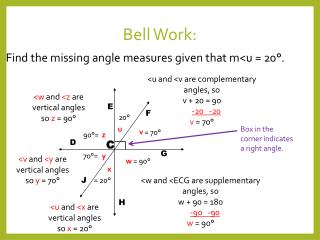
Bell Work: Find the missing angle measures given that m<u = 20°. <u and <v are complementary angles, so v + 20 = 90 -20 -20 v = 70° <w and <z are vertical angles so z = 90° E F 20° u Box in the corner indicates a right angle. v = 70° 90°= z D C G 70°= y <v and <y are vertical angles so y = 70° w = 90° x <w and <ECG are supplementary angles, so w + 90 = 180 -90 -90 w = 90° J = 20° H <u and <x are vertical angles so x = 20°
Angles • An angle consists of two different rays (sides) that share a common endpoint (vertex). Vertex Sides
S vertex R SRT TRS 1 T Naming Angles There are several ways to name an angle. 1) Use the vertex and a point from each side. or side The vertex letter is always in the middle. 2) Use the vertex only. 1 R side This only works if there is only one angle at a vertex. 3) Use a number.
C A 1 B B 1 CBA ABC BAand BC Naming Angles 1) Name the angle in four ways. 2) Identify the vertex and sides of this angle. vertex: Point B sides:
2) What are other names for 3) Is there an angle that can be named XWY or 1 1 YWX XWY YWX 2 ZWX ZWY YWZ XWZ W You Try 1) Name all angles having W as their vertex. X W 1 2 Y Z No!
125° x° A D z 15° B C Find the missing angle measures. You try: <PQR and <RQS are supplementary angles, so mPQR+ mRQS= 180° 125 + y = 180 -125 -125 y = 55° P R Q y° T S <PQR and <TQS are vertical angles. So, the value of x is 125°. <ABD and <DBC are complementary angles, so mABD+ mDBC= 90° z + 15 = 90 -15 -15 z = 75°
You Try: Find the value of x in the figure: The angles are vertical angles. (x – 10) = 125 (x – 10)° x – 10 = 125 125° + 10 +10 x = 135°
You Try: Find the value of x in the figure: The angles are supplementary angles. 120º x + 20 + 120= 180 (x + 20)° x +140 = 180 - 140-140 x = 40°
M L 88° 2x J K N You Try: Find the value of x in the figure: The three angles make a straight angle. 2x + 88 + 46= 180 46° 2x +134 = 180 - 134-134 2x = 46° x = 23°