Environmental Consequences
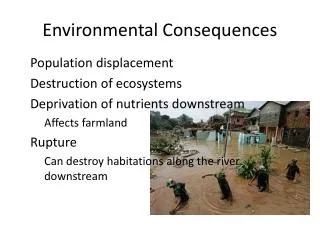
The environmental consequences of water scarcity are profound, leading to population displacement, ecosystem destruction, and nutrient deprivation downstream, which severely affects farmland and habitations along rivers. Water conservation strategies are essential, as depletion of sources can result in higher costs and increasingly polluted water that requires treatment. Effective methods, such as drip irrigation in agriculture and recycling in industry, can mitigate water loss, while future solutions may include desalination and transporting fresh water from distant regions. Emphasizing sustainable practices is crucial for ensuring water availability.

Environmental Consequences
E N D
Presentation Transcript
Environmental Consequences • Population displacement • Destruction of ecosystems • Deprivation of nutrients downstream • Affects farmland • Rupture • Can destroy habitations along the river downstream
Water Conservation • Maintains reasonable prices because… • Depletion of water sources = increased cost: • Wells dug deeper • Water piped greater distances • More polluted water must be cleaned
Water Conservation - Agriculture • Water loss - from evaporation, seepage, and runoff • Drip irrigation systems - deliver small amounts of water directly to plant roots as needed
Water Conservation - Industry • Instead of discharging used water into a nearby river, industries recycle water • Many cities have incentives to save water
Solutions for the Future • When conservation isn’t enough (population growth is explosive): • Desalination • Transporting Fresh Water
Desalination • Removes salt from ocean water • Distillation, reverse osmosis • Too expensive for many nations
Transporting Water • Water can be transported from other regions in huge bladders. • Ex. Greece, US • Use of ice bergs