
Gas Laws
E N D
Presentation Transcript
Gas Laws Read pp. 330-340
The States of Matter • Recall: • Solids have a fixed, definite shape (strong forces between particles) • Liquids take the shape of its container (can be strong forces, but weaker than solids) • Gases have no shape or volume (weak or no forces between particles)
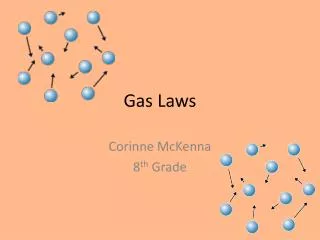
Kinetic Molecular Theory • Explains the relationships between particles, the forces between them and the speed they move at. • States: “All substances contain particles that are in constant, random motion.”
KMT and Gases • Gases move at a far higher speed than solids/liquids and more randomly • Creates large spaces between particles explains why gases are highly compressible • Kinetic energy is the energy of movement. The faster the motion of an object, the greater the kinetic energy • ↑ the temperature ↑ the particle speed = kinetic energy also ↑ as well.
Gas Pressure • Pressure is the force per unit area. • Air is a mixture of N2 gas, O2 gas and small amounts of CO2 gas. Each gas exerts its own pressure, which contributes to the total pressure of air = air pressure. • Air pressure changes when altitude changes
Measuring Pressure • Pascal (Pa) and kiloPascal (kPa), where 1 kPa is 1000 Pa • Atmospheric pressure(atm) measure of the pressure exerted by air • Air is typically measured with 2 units: • kPa • atm (1 atm = 101.3 kPa) • Note: Standard Ambient Temperature and Pressure (SATP) is 25C & 100 kPa
Boyle’s Law • The volume of a gas ↓ as the pressure ↑. • Equation: p1v1 = p2v2 Explains why you feel your chest tighten as you go deeper in the water or be at high altitudes (where the pressure is greater).
Example 1 • Initial V = 43 L at 1.04 atm Final V = ? at 2.94 atm
Example 2 The pressure exerted on a 240 mL sample of hydrogen gas at constant temperature is increased from 0.428 atm to 0.724 atm. What will the final volume of the sample be?
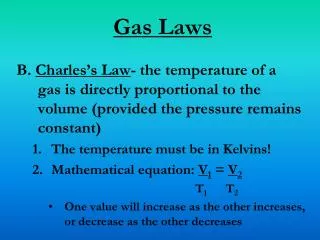
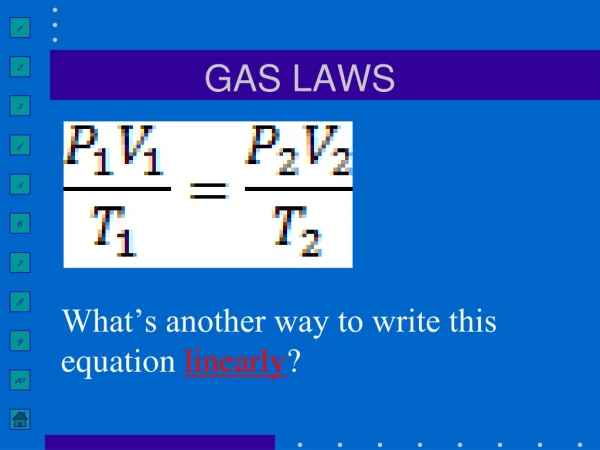
Charles’ Law • As the temperature of a gas ↑, the volume also ↑. Assume pressure is constant. • Equation:
Measuring Temperature • When doing calculations with Charles’ Law, you must convert the temperature from Celsius (C) to Kelvin (K) • 0°C = 273K • If temperature is in °C, just add 273 to it.
Example 1 The volume of a gas inside a cylinder is 0.30 L at 25°C. The gas in the cylinder is heated to 315°C. What is the final volume of the gas after this heating?
Example 2 A sample of neon has a volume of 1.83 L at 23.5°C. At what temperature would the gas occupy 5.00 L? Assume pressure is constant.
Dalton’s Law of Partial Pressures The total pressure of a mixture of non-reacting gases is EQUAL to the sum of the partial pressures of the individual gases. Equation: Ptotal = P1 + P2 + P3 ….
Example 1 A scuba diver’s air tank contains a mixture of nitrogen gas and oxygen gas. The partial pressure for N is 110 atm and for O, it is 28 atm. What is the total partial pressure?
Example 2 A tank of compressed air that is used by a firefighter holds nitrogen at a partial pressure of 300 kPa. The tank has a total pressure of 385 kPa. What is the partial pressure of the oxygen in the tank?