Understanding Waves in Physics: Key Concepts for Exam #1 with Professor Lee Carkner
Prepare for Exam #1 in Physics 202, focusing on wave mechanics under the guidance of Professor Lee Carkner. This lecture outlines essential topics including wave speed in different media, the impact of string tension and linear density on wave motion, and the dynamics of energy transfer in waves. Review key equations, energy types, and the principles behind standing waves, nodes, and antinodes. Bring a calculator and a 3" x 5" note card for formulas. Conduct a thorough review of homework materials, PAL's, and discussion questions to excel in your exam on December 12.

Understanding Waves in Physics: Key Concepts for Exam #1 with Professor Lee Carkner
E N D
Presentation Transcript
String Waves Physics 202 Professor Lee Carkner Lecture 8
Exam #1 Friday, Dec 12 • 10 multiple choice • 4 problems/questions • You get to bring a 3”X5” card of equations and/or notes • Start making it now • I get my inspiration from your assignments • Make sure you know how to do homework, PAL’s/Quizdom, discussion questions • Bring calculator – be sure it works for you
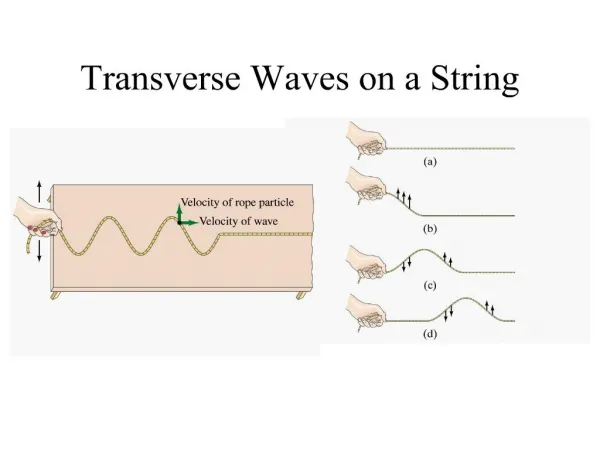
Velocity and the Medium • The speed at which a wave travels depends on the medium • If you send a pulse down a string what properties of the string will affect the wave motion? • Tension (t) • The string tension provides restoring force • If you force the string up, tension brings it back down & vice versa • Linear density (m = m/l =mass/length) • The inertia of the string • Makes it hard to start moving, makes it keep moving through equilibrium
Force Balance on a String Element • Consider a small piece of string Dl of linear density m with a tension t pulling on each end moving in a very small arc a distance R from rest • There is a force balance between tension force: • F = (tDl)/R • and centripetal force: • F = (mDl) (v2/R) • Solving for v, • v = (t/m)½ • This is also equal to our previous expression for v v = lf
String Properties • How do we affect wave speed? • v = (t/m)½ = lf • A string of a certain linear density and fixed tension has a fixed wave speed • Wave speed is solely a property of the medium • We set the frequency by how fast we shake the string up and down • The wavelength then comes from the equation above • The wavelength of a wave on a string depends on how fast you move it and the string properties
Energy • A wave on a string has both kinetic and elastic potential energy • We input this energy when we start the wave by stretching the string • Every time we shake the string up and down we add a little more energy • This energy is transmitted down the string • This energy can be removed at the other end • The energy of a given piece of string changes with time as the string stretches and relaxes • The rate of energy transfer is this change of energy with time • Assuming no energy dissipation
Power Dependency • The average power (energy per unit time) is thus: • P=½mvw2ym2 • If we want to move a lot of energy fast, we want to add a lot of energy to the string and then have it move on a high velocity wave • v and m depend on the string • ym and w depend on the wave generation process
Equation of a Standing Wave • Equation of standing wave: • yr = [2ym sin kx] cos wt • The amplitude varies with position • e.g. at places where sin kx = 0 the amplitude is always 0 (a node)
Nodes and Antinodes • Consider different values of x (where n is an integer) • For kx = np, sin kx = 0 and y = 0 • Node: • x=n (l/2) • Nodes occur every 1/2 wavelength • For kx=(n+½)p, sin kx = 1 and y=2ym • Antinode: • x=(n+½) (l/2) • Antinodes also occur every 1/2 wavelength, but at a spot 1/4 wavelength before and after the nodes
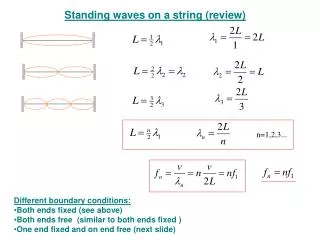
Resonance? • Under what conditions will you have resonance? • Must satisfy l = 2L/n • n is the number of loops on a string • fractions of n don’t work • v = (t/m)½ = lf • Changing, m, t, or f will change l • Can find new l in terms of old l and see if it is an integer fraction or multiple