Download
1 / 43
430 likes | 551 Vues
This lecture by Dr. John Choate provides a comprehensive update on the Safe Motherhood Project, emphasizing the persistent issues surrounding maternal mortality. Participants will learn about the worldwide impact of maternal health, specific challenges faced in New York State and New York City, and the systemic issues affecting maternal care. The session aims to highlight the necessity for local actions, encourage participation in solutions, and look into the alarming statistics regarding maternal deaths. Strategies for improved prenatal and postpartum care will also be discussed.

E N D
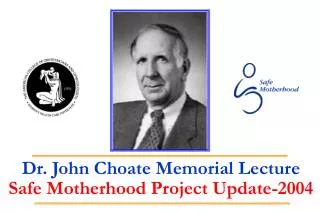
Dr. John Choate Memorial Lecture Safe Motherhood Project Update-2004
Learning Objectives • Comprehend the worldwide impact • List the issues in New York State and NYC • Understand the District II-SMI Project • Discuss the medical and systems issues • Appreciate the need for local “action” • Recognize the opportunity for involvement
Maternal Mortality:Why Must We Still Be Interested? • Measure of the overall effectiveness of our obstetric and general health care system. • Provides asentinel indicator of problems or “gaps” in the health care system.
Daily Death Toll: during pregnancy & in childbirth WORLDWIDE
Worldwide Causes of Maternal Deaths Indirect causes 19% Severe bleeding 25% Other direct causes 8% Sepsis 15% Unsafe abortion 13% Obstructed labor 8% Eclampsia 12%
United Kingdom Confidential Enquiries
Confidential Enquiry • Inception 1952 – a triennial report • Government requires all maternal deaths be subject to CEMD • All relevant hospital professionals & other health professionals must participate in the CEMD
Direct Maternal Deaths Intervention !!! Why Mothers Die 1997 - 1999, CEMD
Facts about TE • 5 fold increased risk during pregnancy • Absolute risk of VT is 0.5 - 3 per 1,000 • PE remains a leading cause of maternal death in United States • 50% of women with a thrombotic event in pregnancy have an underlying congenital or acquired thrombophilia
Frightening Fact • In about 50% of patients with a hereditary thrombophilia, the initial thrombotic event occurs in the presence of an additional risk factor • pregnancy • BCP usage • orthopedic trauma or immobilization • surgery Our Patients !!
Age > 35 years Obesity > 80 kg Parity four or more Labor > 12 hours Gross varicose veins Emergency C/S Pre-op immobility (>4 days) Preeclampsia Current infection Other major illness RCOG - Prophylaxis After C/Section Moderate Risk* * Heparin OR mechanical methods (stockings or SCD boots)
3 moderate risks Personal hx of DVT, PE, thrombophilia, or paralysis Extended C/S C/Hyst Patients with ACA Family history of DVT or PE RCOG - Prophylaxis After C/Section High Risk* * Heparin AND mechanical methods (stockings or SCD boots)
RCOG - Air Travel Recommendations Low-dose aspirin is an acceptable alternative, 3 days before and day of
Maternal Mortality: Nationally and in New York State US Healthy People 2010 Goal: 3.3Per 100,000 livebirths
Maternal Mortality Ratios 1987 - 1996 National: 7.7 / 100,000 (1987-1996)
US Trend in Cause of Pregnancy-Related Death* by Year THE Number 1 Cause * Deaths among women with a livebirth
Pregnancy-Related Mortality Ratio (PRMR)* by Race & AgeUS, 1991 - 1997 * Deaths among women with a livebirth Source: CDC, 2002.
Maternal Mortality Ratios for Caucasian Women:1987-1996 Note: The colors on these maps show the states divided into three terciles based on their MMR.
Maternal Mortality Ratios for African-American Women 1987-1996 Source: NCHS, Vital statistics
2000 NYS Maternal Mortality Ratios 9.5 in Upstate New York 23.1 in NYC 15.9 in NYS *Per 100,000 livebirths
New York City Maternal DeathsDirect & Indirect1998 - 2000 119 cases out of 169 Total • Hemorrhage32% • Hypertension 10% • Cardiomyopathy 8% • Embolism 7% • Infection/Sepsis 7% • Anesthesia 7% Courtesy of Dr. Gina Brown, NYCDOH, BMIRH
NYC Maternal Deaths Courtesy of Dr. Gina Brown, NYCDOH, BMIRH
Location and Timing of Death • 70 % Died in the hospital • 45% Died within 24 hours of birth Courtesy of Dr. Gina Brown, NYCDOH, BMIRH
HELLP 5% Previa 5% Atony/PP Hem 15% A/Per/Increta 5% Coagulopathy 13% AFE 10% Abruptio 3% Ectopic 5% Other placenta 3% Unspec/Unknown 36% Hemorrhage DeathsRelated Causes N = 39 Courtesy of Dr. Gina Brown, NYCDOH, BMIRH
Approximately one-half of all maternal deaths are considered to be preventable!!
NYS Safe Motherhood Project • Proposal drafted by Dr. John Choate • Patterned after the Confidential Enquiry • Developed with NYS/District II • Funded by Commissioner’s Priority Pool • Protected by PHL 206 (1)(j) • ACOG Partners with RPCs – Quality expectation • On-site death review teams
Issues to Review: Quality and Content of Medical Care • Preventive services - chronic illnesses • Community and patient education • Nutrition, substance abuse, social services • Preconception counseling • Prenatal care access • Labor and delivery care – Consulting Services • Postpartum care and follow-up Source: CDC, 2002.
Issues to Review:Systems and Social Causes of Death • Intendedness of pregnancy • Woman and her family’s knowledge and decision making ability • Timeliness of woman's actions to seek care • Accessibility and acceptability of care Source: CDC, 2002.
Methods to Identify Deaths • Death Certificates: Primary source • Linkage to and Searches of other databases • Reports from providers, hospitals, clinics, medical examiners, ED physicians, media • Review of autopsy and medical records • Computer linkage of vital records
32. WAS DECEDENT HOSPITALIZED IN LAST TWO MONTHS? NO YES 0 1 CONFIDENTIAL SEE INSTRUCTION SHEET FOR COMPLETING CAUSE OF DEATH CONFIDENTIAL APPROXIMATE INTERVAL BETWEEN ONSET AND DEATH 30. DEATH WAS CAUSED BY: (ENTER ONLY ONE CAUSE PER LINE FOR (A), (B), AND (C) PART I. IMMEDIATE CAUSE: (A) DUE TO OR AS A CONSEQUENCE OF: (B) DUE TO OR AS A CONSEQUENCE OF: (C) CAUSE OF DEATH PART II OTHER SIGNIFICANT CONDITIONS CONTRIBUTING TO DEATH BUT NOT RELATED TO CAUSE GIVEN IN PART I (A): 31A. IF INJURY DATE: MONTH DAY YEAR HOUR: 31B. LOCALITY: (City or town and county and state) 31C. DESCRIBE HOW INJURY OCCURRED m 33B. DATE OF DELIVERY: 33A. IF FEMALE WAS DECEDENT PREGNANT IN LAST 6 MONTHS? NO YES 0 1 31D. PLACE OF INJURY MONTH DAY YEAR
Safe Motherhood Initiative The American College of Ob-Gyn District II/ NY Chair: Jeffrey C. King, MD, FACOG Project Director: Cathy Chazen Stone, MS Neisha M. Torres, RN, MS Executive Director: Donna Montalto Williams, MPP Contracted by the Women’s Health Bureau, NYS Department of Health
The Safe Motherhood Initiative uses… • NYS Regional Perinatal Network expects the RPCs to conduct quality assurance and quality improvement activities with their affiliate hospitals. … review of all maternal deaths is part of that role.
Maternal Mortality Review Team • Maternal-Fetal Medicine/RPC • Labor & Delivery nurse/RPC or Nurse coordinator/RPC • General Ob-Gyn/ACOG • Project Director/ACOG • Sub-specialist/RPC (as needed)
SMI – Project Summary • Death notifications = 21, Review = 15, Pending = 2 • Cause of Death • Sepsis 4 • Embolism 3 • Hypertensive Disease 5 • Hemorrhage 1 • Congenital Cardiac Disease 1 • Unknown 1
Ethnicity White 30% Asian 8% Haitian 8% Black 46% Hispanic 8% Age < 20 11% 20 – 30 39% 30 – 40 39% > 40 11% SMI – Project Summary
Issues Identified • Medical Care – recognition and transfer • Blood bank procedure • EMS protocols & ED process • Availability of Diagnostic studies • Translation Services • Grief Counseling for Family and Staff • Consulting issues – willingness and adequacy
What Can You Do? • Review your institutional Policy and Procedures • Encourage Emergency Drills • Confront Cultural Competency • Admit Your Limitations Remember: It’s The Patient That Really Matters!!!
For more information contact Cathy Chazen Stone, MS Project Director, Safe Motherhood Initiative American College of Obstetricians and Gynecologists, District II/ NY 152 Washington Avenue Albany, New York 12210 Telephone: 518.436.3461 Fax: 518.426.4728 Email: cstone@ny.acog.org
Learning Objectives • Comprehend the worldwide impact • List the issues in New York State and NYC • Understand the District II-SMI Project • Discuss the medical and systems issues • Appreciate the need for local “action” • Recognize the opportunity for involvement
My Thanks to All Who HaveSupported and ContributedTo the Success of This Project