Effective Management of Universal Waste at the University of Rochester Strong Memorial Hospital
This case study explores the universal waste management strategies implemented at the University of Rochester Strong Memorial Hospital, focusing on hazardous waste compliance and collection systems. Led by Marvin Stillman, Manager of Environmental Compliance, the initiative addresses regulatory challenges involving hazardous waste batteries, lamps, and pesticides. It highlights the importance of convenience in collection points, effective staff training, and collaboration with central pest control. The program aims to maintain compliance while minimizing environmental impact and promoting sustainability within the institution.

Effective Management of Universal Waste at the University of Rochester Strong Memorial Hospital
E N D
Presentation Transcript
Universal Waste Case Study University of Rochester Strong Memorial Hospital Marvin Stillman, Manager Environmental Compliance
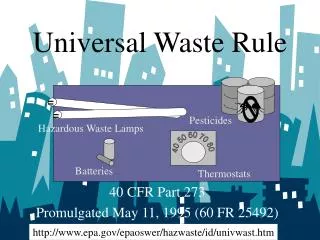
Universal Waste • Are already regulated as Hazardous Waste • HW batteries • Thermostats • HW recalled pesticides • HW mercury lamps
The Choices • Manage • Under full HW Rules • Manage • Under relaxed Universal Waste Rules • Do Not Manage • Face penalties for non-compliance
Background • Hopelessly Large Quantity Generator • HW = 21 TPY entire university • Share EPA ID with University • Large Medical Research Complex • Graduate/Undergraduate campus • Share EH&S with University
Collection Considerations • Collection Points set up • Convenience is important • Incorporate into existing handling processes • Follow labeling requirements
Battery Collection Points • Facilities & Services • At point where new batteries are picked up • Clinical • Soiled utility cart for later segregation • Special bin in cart cleaning area • General Public and Staff • Service desks such as Page Office or Information desk
Battery Collection Con’t • Service Shops • Medical Engineering • Photo Illustration • Option to call for direct pickup by Hazardous Waste Management staff
Lamps • Separate collection was set up in an area on the way to the dumpster. • Brought to central University Hazardous Waste Facility for ultimate disposal. • Hauler exchanges large cardboard tubes for 4’ lamps • The rest are in boxes on pallets
Recalled Pesticides • Avoided through Integrated Pest Management • Managed as HW if there is any for disposal • All pesticides are handled by central pest control department • Universal Waste option for recalled pesticides is not really beneficial for our situation
Computers • Regulated as Hazardous Waste • Throwing away is not an option • Not Universal Waste----yet • NYSDEC scrap metal ruling for NY • Managed through a local electronics recycling firm
Challenges • Change staff thinking through education • These cannot be thrown away • Items are seen as common and non-threatening • Incorporate new policy into training classes • Write articles in campus publications • Get supervisors to enforce
Challenges 2 • You get no more staff • Incorporate separation and collection into existing materials flow • Computers and lamp collection areas are located near other trash dumpsters • The same staff that used to pick them up still do • They now keep them separated • Or collect used when new items are picked up
Challenges 3 • Sell to administration • This has not been a problem • Special management is legal requirement • Cost-effective contracts were negotiated • Existing operations used to manage where possible • Credibility of Environmental staff not questioned • Success tracked and reported • Sell minimal compliance before addressing going beyond compliance
Benefit • UR to stay below 25 tons per year HW • Proposed NYS generator tax hike of $4,000 year if over 25 tons • Longer storage time for certain HW batteries such as button to fill container • Other institutions may be able to lower generator status to minimize regulatory impact
Minimal Operational Benefit to UR • Thermostats • Shipped with other HW • Recalled Pesticides • No reason to hold on to these