Universal Waste Action Plan: Addressing Household Hazardous Waste Challenges
The Universal Waste Action Plan, established on February 8, 2006, tackles the growing issue of household hazardous waste (HHW) and universal waste (U-waste) management. These waste types, including common products like batteries, fluorescent bulbs, and automotive fluids, pose environmental and health risks. The plan aims to enhance local infrastructure, streamline HHW collection, and educate the public on proper disposal methods. With significant financial implications, estimated at over $40 million annually, the initiative focuses on immediate and long-term strategies for better waste management and outreach.

Universal Waste Action Plan: Addressing Household Hazardous Waste Challenges
E N D
Presentation Transcript
Universal Waste Action Plan February 8, 2006
What is Household Hazardous Waste? • Common household products that are poisonous, explosive, ignitable, or corrosive, such as: • Automotive products (motor oil, antifreeze, etc) • Paints • Solvents • Cleaning products • Pesticides, Herbicides & Insecticides
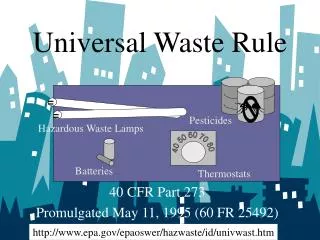
What is Universal Waste? • Hazardous waste that US EPA & DTSC determined: • Poses a lower risk to people and the environment • Is generated widely by households and small businesses • Has reduced management requirements
Why is U-waste an Issue Today? • Temporary “exemption” allowing continued disposal some u-waste in household trash expiresFebruary 8, 2006 • Sufficient infrastructure for collection & recycling not developed during exemption • The problem for local government: • Increased volumes of material at HHW facilities • Need to inform public how & where to dispose of U-Waste • $40+ Million estimated annual cost to local jurisdictions for collection, handling & management
Today’s Ban Impacts…. • Small batteries • Fluorescent light bulbs • Consumer electronics not covered by SB 20/50
What We’ve Been Doing… • Focused last five HHW Grant Cycles on U-Waste • Piloted local retail take-back options • Board approved contract concept for development of model HHW/Used Oil collection facilities • Provided outreach at HHWIE bi-monthly meetings • Streamlined Form 303 data collection to include U-waste and E-waste • Focused sessions on U-Waste at last Annual HHW Conference • Posted advisory to LEAs on U-waste (P&E)
Short Term Priorities(Next Two Weeks) • HHW Grant cycle to focus on U-waste (Feb 2006) • Web page revisions to highlight U-Waste & link with DTSC and local jurisdiction web pages • Outreach efforts continuing • One page fact sheet, stickers and posters • Creating CD-ROM with outreach materials for locals • Radio PSAs • Press Kits • Press Releases
Mid Term Priorities(Next 30-180 Days) • Award Grants for coordination planning by counties • Award Infrastructure Grants for locals (August 2006) $ 4 million for competitive U-Waste projects: • Build new facilities or expand existing facilities • Targeted U-waste programs • Develop How-To Guides on setting up local programs (w/ DTSC) • Continue Outreach • Create 15 and 30 second video PSAs for distribution to statewide markets • Incorporate U-waste at other conference and public events
Longer Term Priorities(Next 6-12 Months) • Corporate Outreach • RFP for Corporate Relation Services to conduct outreach to major retailers to implement take-back • Product stewardship initiatives including manufacturer responsibility • Annual HHW grants for facilities • Transitional & Long Term Financing Options • RFP to explore models, e.g. 3rd Party Organizations, deposit/incentive system, advanced disposal fee, take-back, etc.
Recommended Board Action to Support U-waste Action Plan • Approve Feb. 2006 HHW Grant Criteria • Coordination Grants to local jurisdictions • U-waste as priority competitive grant focus • Approve IWMA funded Allocation Concept for U-Waste financing options • Approve IWMA funded Allocation Concept for statewide U-Waste outreach • For Corporate Relations Services to major California retailers to implement take-back