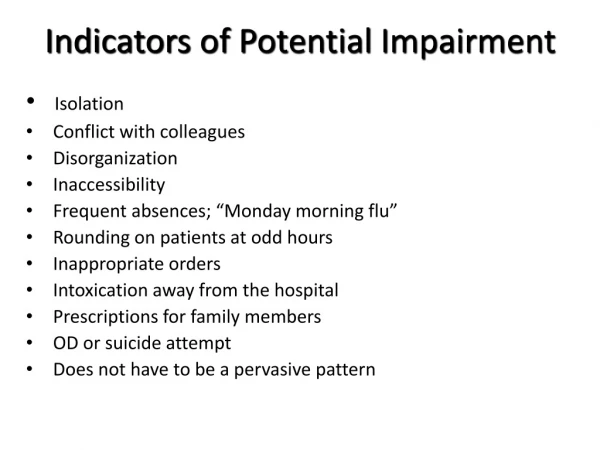
Indicators of Potential Underperformance
This article delves into the concept of Indicators of Potential Underperformance (IPU) in GP training, offering insights into how these indicators can assist in identifying early signs of trainee difficulties. It discusses how the RDMP model can be utilized for enhanced understanding, focusing on the core competencies required for effective GP practice. Moreover, the piece emphasizes the importance of providing constructive feedback and the potential reasons behind underperformance, encouraging educational leaders to remain vigilant and responsive to IPUs to foster improvement and maintain high standards in primary care.

Indicators of Potential Underperformance
E N D
Presentation Transcript
Today • What is an IPU? How can we use them? • Does the RDMP model help? • Educational prescriptions.
Reminder RCGP Curriculum Statement: 1. Core Statement: Being a GP
Being a GP: 12 Competencies • Communication and consultation skills • Practisingholistically • Data gathering and interpretation • Making a diagnosis and making decisions Clinical management • Managing medical complexity • Primary care administration and IMT • Community orientation • Maintaining performance, learning and teaching • Maintaining an ethical approach to practice • Fitness to practise
Eportfolio • Word pictures: positive descriptors • NFD, Competent and Excellent • On CBD or ESR
Indicators of Potential Underperformance • Aim to identify early TID • Then offer targeted feedback and remediation
IPU • “These go beyond the opposites and add useful meaning or emphasis to the themes that they are placed alongside”. • Not a level below NFD eg may alter excellent to competent
IPU • Added to word pictures on E-portfolio…
So if IPU noted – what to do? Discuss with trainee Offer feedback and suggestions
So if IPU noted – what to do? Is it significant: Recurrent? Noticed by others? Apparent in other situations/areas?
A unifying theory of clinical practice: Relationship, Diagnostics, Management and professionalism (RDM-p). Norfolk T, Siriwardena AN. Qual Prim Care. 2009;17(1):37-47
RDM-p (2009) • Links 12 competencies into 4 clusters • Creates links between the competencies to help us understand the relationship between them • Can be used diagnostically ….
RDMP (2009) • http://www.wpba4gps.co.uk/fileadmin/user_upload/secure/mindmaps/Understanding_the_Theory/Competence_Framework/RDMp_Master/RDMp_Master-V2.pdf
What are the reasons for underperformance • This may be beyond today but remember include • Poor training for general practice; • Lack of continuing education; • Isolation from colleagues; • Physical health problems; • Mental health problems including alcohol and drug abuse; • Stress related to work or domestic situations; • Low morale; • Excessive workload; • Poor practice infrastructure; • Poor relationships within a practice; • Poor premises and facilities; and • Poor communication and relationship with Educational Leaders.
Educational prescription? • Do not ignore IPU • Establish if significant • Be aware of reasons for underperformance • Consider how our feedback and educational planning are affected by the IPU