Functional Properties of Hemocyanin from Oncomelania hupensis: Insights into Schistosoma japonicum
This study investigates the functional properties of hemocyanin extracted from the intermediate host Oncomelania hupensis, which plays a crucial role in the lifecycle of Schistosoma japonicum. The research focuses on phenoloxidase activity, showing serological cross-reactions with S. japonicum infection, and explores potential carbohydrate-mediated molecular mimicry. Utilizing techniques such as SDS-PAGE, spectroscopic analysis, and electron microscopy, the findings add to our understanding of the biochemical interactions that could influence schistosomiasis transmission and host-pathogen dynamics.

Functional Properties of Hemocyanin from Oncomelania hupensis: Insights into Schistosoma japonicum
E N D
Presentation Transcript
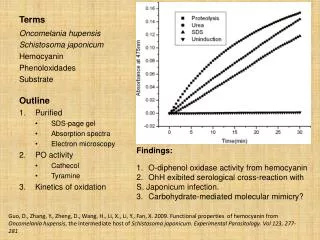
Terms Oncomelaniahupensis Schistosomajaponicum Hemocyanin Phenoloxidades Substrate Outline Purified SDS-page gel Absorption spectra Electron microscopy PO activity Cathecol Tyramine Kinetics of oxidation Findings: O-diphenoloxidase activity from hemocyanin OhHexibited serological cross-reaction with S. Japonicum infection. 3. Carbohydrate-mediated molecular mimicry? Guo, D., Zhang, Y., Zheng, D., Wang, H., Li, X., Li, Y., Fan, X. 2009. Functional properties of hemocyanin from Oncomelania hupensis, the intermediate host of Schistosoma japonicum. Experimental Parasitology. Vol 123, 277-281