Download
1 / 24
240 likes | 388 Vues
This section explores the limits of cell growth, emphasizing diffusion, DNA control, and the importance of a high surface area-to-volume ratio. When cells exceed optimal size, division occurs, leading to the formation of two new cells. The cell cycle is divided into interphase (cell growth and DNA replication), mitosis (nuclear division), and cytokinesis (cytoplasmic division). It outlines the stages of mitosis (prophase, metaphase, anaphase, telophase) and discusses the regulation of the cell cycle through internal and external factors, including cancer and apoptosis.

E N D
Cell Growth and Reproduction Section 10.1 and 10.2 Biology
Limits to cell growth • Diffusion – diffusion slows w/larger distances • DNA – DNA can only control the needs of a small cell • Cell Size - Surface area-to-volume ratio must be high; 6/1; cell has trouble transporting materials in/out of the cell if it’s too low like 2/1
The larger the cell, the lower the ratio (surface area to volume), the harder to transport materials. • Solves these problems with cell division (making 2 new cells) • Cell Division – when a cell gets too large to control or function efficiently, cell division takes place
Cell division 10.2
Chromosomes • Chromosomes are carriers of our genetic material & must be copied & transmitted accurately • Chromosomes are tightly coiled chromatin. • Most of the time our chromosomes exists as chromatin (long strands of DNA wrapped around proteins called histones)
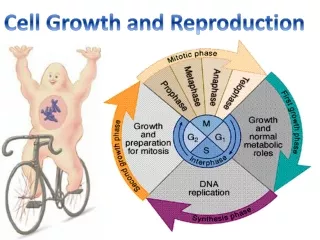
Cell Cycle (3 stages) • Sequence of growth (interphase), nuclear division (mitosis), and cytoplasmic division (cytokinesis) of a cell
Interphase (1st stage) • G1 – growth phase – cell gets bigger and develops • S – synthesis phase – DNA in nucleus is copied • G2 – growth phase – preparation for mitosis; produce more organelles, enzymes, centrioles are replicated, etc.
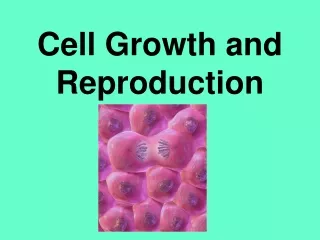
Mitosis – PMAT (2nd stage) • nuclear division • yields two daughter nuclei that are genetically identical • used for growth and healing
4 stages to mitosis • Prophase - prepare • Metaphase - middle • Anaphase - away • Telophase – two cells
Prophase • Chromatin condenses into chromosomes, 2 identical strands of DNA attached by a centromere • Centrioles move to opposite ends of the cell • Nuclear envelope and nucleolus disappear • Spindle starts to appear
Metaphase • Chromosomes line up about midway between the centrioles • Spindle fibers attach to chromosomes at centromeres
Anaphase • Centromeres are pulled apart as spindle fibers contracts • Chromatids (half of a chromosome) are pulled in opposite directions • Chromatids are pulled to opposite ends of the cell
Telophase • Chromatids complete journey to the ends of the cell • Chromatin is formed as DNA elongates • Nuclear envelope forms around each set of DNA • Spindle disappears • Nucleoli appear in each nucleus
Cytokinesis (3rd stage) • Cytoplasmic Division • Begins during anaphase • In animal cells a furrow / ring starts to develop in the middle of the cell membrane (pinching of the middle)
Cytokinesis • In plants, you start to develop a cell plate (starts in middle of the 2 cells) • Ring contracts until it completely separates the two new nuclei and about ½ organelles into each new cell
Control of the Cell Cycle • cyclins (proteins) regulate cell growth • Internal regulators – only move to the next phase of the cell cycle when the previous phase is complete
Control of the Cell Cycle • External regulators – if there is room, a cell divides; if neighboring cells are touching, cell growth is inhibited because space is scarce
Cancer • Uncontrolled cell growth • Tumors are cells that do not respond to cell regulators • Cells could also become “immortal”; they don’t finish cell development and die, so new cells just build up
Apoptosis – programmed cell death • Normal part of development for most cells in a multi-celled organism (50 - 70 billion cells die each day in the average human adult.) • Once cells stop dividing or specializing; special enzymes will break it down & scavenger WBCs come & clean up