Download
1 / 9
90 likes | 224 Vues
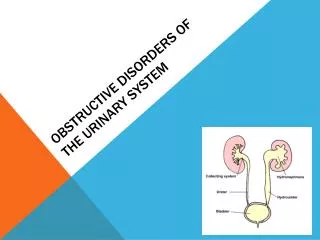
This article focuses on various disorders of the urinary system, highlighting renal calculi (kidney stones), nephritis, incontinence, and cystitis. Kidney stones form from calcium phosphate and uric acid crystals and can cause severe pain and obstruction. Cystitis, often caused by E. coli, leads to painful urination, particularly in females. The article details diagnoses like ultrasound, treatment options including medications and lithotripsy, and addresses hemodialysis and kidney transplants as solutions for kidney failure.

E N D
Disorders of the Urinary System Can you guess one?
Renal Calculi (Kidney Stones) • Made of crystals of calcium phosphate and uric acid • Gradually they get larger until they block ureters • First sym severe pain • Other sym nausea and vomiting, frequency, chills, fever, hematuria • Diagnosis by symptoms, ultrasound, or x-ray • Rx –increase fluids to flush out stone, medications, and if needed LITHOTRIPSY
Lithostripsy • Surgical procedure to remove kidney stones • Shock waves hit dense stones and break them up • Done on outpatient basis
Nephritis • Inflammation of the kidney (kidney infection) • Incontinence –involuntary urination
Cystitis • Inflammation of the mucous membrane lining of the urinary bladder • Most common cause – E.Coli • Sym- DYSUIA (painful urination) and frequency • Usually in females (shorter urethra) • Rx - antibiotics
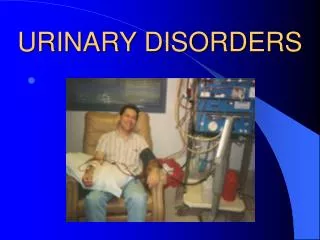
Hemodialysis • Used for kidney failure • Involves the passage of blood through device with semipermeable membrane • Dialysis serves as substitute kidney • Blood from patient flows through machine and is filtered • Can be done at home or in clinic • Takes 2-4 hours, 2-3 times a week.
Kidney Transplant • As a last resort • Involves donor organ from someone with a similar immune system • Main complication - rejection