Understanding Data Analysis: Correlation Coefficient and Mean Absolute Deviation
This educational resource focuses on calculating and interpreting the correlation coefficient and mean absolute deviation. It includes practical examples, such as quiz scores and students' earnings from tips, to illustrate the concepts. You will learn how to determine the median, quartiles, and the overall distribution of data, including measures of central tendency. The materials also cover data visualization with histograms and two-way tables, providing insights into real-world scenarios that affect choice behaviors like drink sizes in different seasons.


Understanding Data Analysis: Correlation Coefficient and Mean Absolute Deviation
E N D
Presentation Transcript
ECOT Review Unit 4 – Describing Data
1. The table shows the scores of four students on their first four math quizzes. Mean Absolute Deviation Which student had the least mean absolute deviation on the quiz scores?
5-Number Summary • Put data in order, smallest to largest • Find the median (middle number) • Find Q1 (median lower half) • Find Q3 (median upper half) • Min and Max
Measures of Central Tendency Which of the following correctly displays the data in the set A B C D
Josh and Richard each earn tips at their part-time job. This table shows their earnings from tips for five days Total Tips by Day Day Josh’s Tips Richard’s Tips Monday $40 $40 Tuesday $20 $45 Wednesday $36 $53 Thursday $28 $41 Friday $31 $28 • Who had the greatest median earnings from tips? • Josh • Richard
Histograms and Shape Height (in inches) Frequency 42 1 43 2 44 4 45 5 46 4 47 2 48 1 Mr. Storer, the physical education teacher, measured the height of the students in his first period class. He organized his data in this chart. Which of the following best describes the data? • Normal Distribution • Skew Left • Skew Right • Bimodal distribution
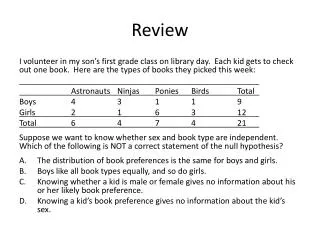
Two Way Tables A fast food restaurant wants to determine if the season of the year affects the choice of soft drink size purchased. They surveyed 278 customers and the table below shows their results. The drink sizes were small, medium, large, and jumbo. The seasons of the year were spring, summer, and fall. Which of the following is a true statement? Spring Summer Fall Small 24 22 18 Medium 23 28 19 Large 18 27 29 Jumbo 16 21 33 A. Only 18 small sodas were sold in the year B. 30% of sodas were bought in summer C. 2/3 of all sodas sold were size medium D. Over 50% of the sodas bought at least size large
Which Correlation Coefficient best matches the data? • 0.91 • -0.34 • -0.83 • -0.25