Fast Fourier Transform for Protein Docking Optimization
Utilizing Fast Fourier Transform for efficient protein docking predictions. Evaluating success rates and hit counts using rotational sampling density. Learn how Pairwise Shape Complementarity enhances binding energy calculations.

Fast Fourier Transform for Protein Docking Optimization
E N D
Presentation Transcript
Protein Docking Rong Chen Boston University
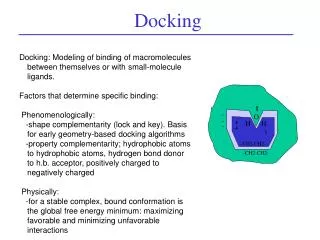
L L L L R R L R R R The Lowest Binding Free Energy DG water
R Fast Fourier Transform R Discretize Complex Conjugate R Correlation function L Rotate Discretize L L Fast Fourier Transform Surface Interior Protein Docking Using FFT
Rotational Sampling • Evenly distributed Euler angles
Performance Evaluation • Success Rate: given the number of predictions(Np), success rate is the percentage of complexes in the benchmark for which at least one hit has been obtained. • Hit Count: the average number of hits over all complexes at a particular Np.
R Fast Fourier Transform R Discretize Complex Conjugate R Correlation function L Rotate Discretize L L Fast Fourier Transform Surface Interior Protein Docking Using FFT
R IFFT Correlation L Y Translation X Translation Surface Interior Binding Site Protein Docking Using FFT Increase the speed by 107
van der Waals energy; Shape complementarity Desolvation energy; Hydrophobicity Electrostatic interaction energy Translational, rotational and vibrational free energy changes An Effective Binding Free Energy Function Number of atom pairs of type i Desolvation energy for an atom pair of type i
1 1 1 1 1 1 1 9i 9i 9i 9i 9i 1 9i 9i 9i 9i 9i 1 1 1 1 1 1 9i 9i 9i 9i 1 1 9i 1 1 9i 9i 9i 1 1 1 1 9i 9i 1 9i 9i 9i 9i 9i 1 1 1 1 9i 9i 9i 9i 9i 1 1 1 1 1 1 1 RGSC LGSC Grid-based Shape Complementarity
1 1 2 3 3 3 2 2 2 3i 3i 3i 3i 3i 3 3i 9i 3i 3i 3i 2 1+3i 1+3i 3 5 2 3i 9i 3i 1 1+9i 1+3i 1+3i 1+9i 1+3i 3 3i 9i 3i 5 2 1 1+3i 1+3i 1+9i 1+9i 1+3i 3i 9i 3i 3i 3i 3 2 1+3i 1+3i 3i 3i 3i 3i 3i 2 2 2 3 3 3 2 1 1 RPSC LPSC PairwiseShape Complementarity
A C B D Why PSC works better than GSC?
van der Waals energy; Shape complementarity Desolvation energy; Hydrophobicity Electrostatic interaction energy Translational, rotational and vibrational free energy changes An Effective Binding Free Energy Function Number of atom pairs of type i-j Desolvation energy for an atom pair of type i-j
Other available Docking Software • Fast Fourier Transform or FFT (Katchalski-Katzir, Sternberg, Vakser, Ten Eyck groups) • Computer vision based method (Nussinov group, 1999) • Boolean operations (Palma et al., 2000) • Polar Fourier correlations (Ritchie & Kemp, 2000) • Genetic algorithm (Gardiner, Burnett groups) • Flexible docking (Abagyan, 2002)
3D-Dock • Michael J.E. Sternberg, Imperial Cancer Research Fund, London, UK. • FTDock: Grid-based shape complementarity, FFT. • RPScore: empirical pair potential. • MultiDock: refinement. • http://www.bmm.icnet.uk/docking/index.html
GRAMM • Ilya A. Vakser, State University of New York at Stony Brook. • Geometric fit and hydrophobicity • FFT • Low resolution docking • http://reco3.ams.sunysb.edu/gramm/
DOT • Lynn F. Ten Eyck, University of California, San Diego. • Grid-based shape complemetarity, elctrostatics • FFT • http://www.sdsc.edu/CCMS/Papers/DOT_sc95.html
ICM • Ruben Abagyan, The Scripps Research Institute, La Jolla. • Pseudo-Brownian rigid-body docking • Biased Probability Monte Carlo Minimization of the ligand interacting side-chains. • http://abagyan.scripps.edu/lab/web/man/frames.htm
HEX • Dave Ritchie, University of Aberdeen, Aberdeen, Scotland, UK • spherical polar Fourier correlations • http://www.biochem.abdn.ac.uk/hex/
Approach Overview PDB2 PDB1 PDB Processing ZDOCK: Initial-stage Docking Biological information RDOCK: Refinement-stage Docking Clustering Final 10 predictions
Example: • CAPRI Target 6: α-amylase / Camelid VHH domain