Understanding the Production of Alcohols and Carboxylic Acids Through Fermentation and Reactions
This article explores the processes of fermentation used to produce alcohols, specifically in winemaking, where yeast converts sugars into ethanol and carbon dioxide under anaerobic conditions. The optimal fermentation temperature is 37°C. Additionally, it discusses modern methods of ethanol production through the reaction of ethene with steam at high temperatures and pressures. The text also covers the oxidation of alcohols to form carboxylic acids, highlighting methanoic acid and the formation of esters, which arise from the reaction between alcohols and organic acids.

Understanding the Production of Alcohols and Carboxylic Acids Through Fermentation and Reactions
E N D
Presentation Transcript
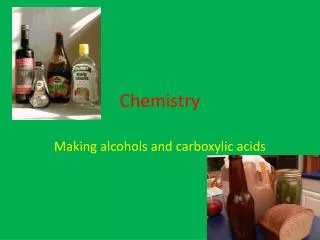
Chemistry Making alcohols and carboxylic acids
Fermentaion • Fermenaion is the process of energy production in a cell under anaerobic conditions (without oxygen)Wine goes through fermentation. Yeast is added to a sugar and grape solution without any air. These Anaerobic conditions change yeast into glucose and carbon dioxide.
New Ways of making ethanol Reacting ethene with steam (C2H4 + H2O C4OH)They are passed through steam and mus be done at 300 degrees celsious at 60-70 atmosphere
Carboxylic acids • Alcohols can be oxidise to make carboxylic acids. Methanoic acid is a carboxylic acid the fuctional group is is C=O-O-H.Things that use carboxylic acids are like vinegar.
Esters are compounds formed from the reaction between alcohols and acids. The word 'ester' alone now signifies by common usage that the acid is an organic acid, but inorganic acids can also form esters - ATP is an example well-known to biology students, being a phosphate ester. Even halogenoalkanes can be regarded as inorganic esters, of alcohols and hydrochloric acid. This section is, however, confined to esters of organic acids RCOOR' where R can be hydrogen or an organic group: