Download
1 / 4
40 likes | 157 Vues
This entry provides essential terminology related to titration, a crucial method in analytical chemistry. Titration involves the controlled mixing of a solution of unknown concentration with a standard solution. Key terms include Primary Standard, a pure compound used for comparison; Secondary Standard, accurately known solutions; and Standard Solution, a known concentration. Additionally, Equivalence Point, where equal amounts of reactants react, and indicators like Phenolphthalein, which change color to signal this point, are discussed. This overview is vital for mastering titration techniques.

E N D
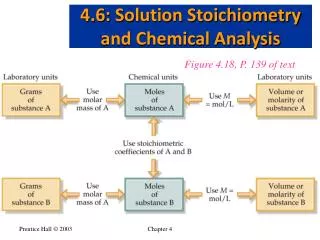
4.6: Solution Stoichiometry and Chemical Analysis Figure 4.18, P. 139 of text Chapter 4
Titration Terms • Titration: Controlled combination of a solution of unknown concentration with a solution of known concentration • Primary Standard: A relatively pure compound with a • high molar mass • known pattern of reactivity • used as a basis of comparison for the determination of the concentration of an unknown • Secondary Standard: A solution with a molarity that is very accurately known • Standard Solution: A solution of known concentration. Chapter 4
Titration Terms, continued • Equivalence Point: Stoichiometrically equivalent amounts of substances are combined • Indicator: Dyes used to indicate the equivalence point (color change) • Phenolphthalein: colorless in an acid, pink in a base • End Point: the point of color change that coincides with the equivalence point. Chapter 4