Download
1 / 35
350 likes | 480 Vues
This document summarizes discussions from the September 2006 NASA/GISS workshop focused on entrainment and microphysics in cloud dynamics, specifically related to RICO Cu. Key topics include classical entrainment concepts, erosion and detrainment processes, and various microphysics issues such as homogeneous versus inhomogeneous mixing. It highlights contributions from prominent researchers and provides a detailed analysis of data from RICO flights, emphasizing the importance of entrainment scales, cloud condensation nuclei (CCN), and turbulence effects on microphysical processes.

E N D
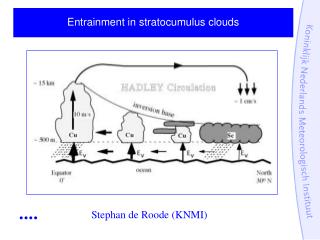
ENTRAINMENT and MICROPHYSICS in RICO Cu Hermann Gerber NASA/GISS Workshop Sept. 2006
CLASSICAL ENTRAINMENT CONCEPT Erosion (Detrainment) Rising Toroidal Thermal Entrainment X Scorer, R.S., and F.H. Ludlam: 1953: Bubble theory of penetrative convection. Q.J. Roy. Meteor. Soc., 79, 317-341. (Blyth, A.M., et al., 1988: J. Atmos. Sci., 45, 3944-3964.) (Baker, B., A., 1992: J. Atmos. Sci., 49, 387-404.) (Damiani, et al, 2006: J. Atmos. Sci., 63, 1432-1450)
MICROPHYSICS ISSUES 1. Homogenous or inhomogeneous mixing? 2. What about entrained CCN? 4.Super-AdiabaticDrops? 3. Entrainment scales?
HOMOGENOUS MIXING INHOMOGENEOUS MIXING ADIABATIC PEAK SUPER ADIABATIC (Lasher-Trapp, S., W. Cooper, and A. Blyth, 2005: QJRMS, 195-220)
CONDITIONAL SAMPLING FOR ACTIVE TURRETS VERTICAL VELOCITY IS POSITIVE (~80%) IN AREA WITHLWC TOP OF CLOUD IS VISIBLE IN FORWARD-LOOKING VIDEO CLOUD IS TRAVERSED NEAR CLOUD TOP A SINGLE TURRET IS TRAVERSED (Raga, G.B., et al, 1990: J. Atmos. Sci., 47, 338-355.)
PVM FSSP Fast FSSP
INHOMOGENEOUS EXTREME HOMOGENEOUS c or (Brenguier, J.-L.,and F. Burnet, 1996: 12th Int. Conf. Clouds and Precip; Zurich; 67-70) (Gerber, H., et al, 2001: J. Atmos. Sci., 58, 497-503) (Burnet,F., and J.-L. Brenguier, 2006: J. Atmos. Sci., in print) (Schleuter, M.H., 2006: Master’s Thesis, U. of Utah)
(Blyth A.M., and J. Latham, 1991: J.A.S., 48, 2367-2371) (Gerber, H., et al, 2000: 13th Int.Conf. Clouds and Precip., Reno, NV, 105-108)
COMPOSITE FRACTIONAL ENTRAINMENT RICO, RF12 .0062 djc /dz = -e (jc- je) e = fractional entrain. j = scalar = qT e =environment c = cloud
COMPOSITE TKE DISSIPATION TKE (diss. rate) = [v’(rms)]3/L v’ = gust velocity L = penetration length = 40m TKE INHOMOGENEOUS
CLOUD EDGE 1000 Hz -60 -50 -40 -30 -20 -10 0 10 20 (Brenguier, J.-L, 1993: J. Appl. Meteor., 32, 783-793)
COMPOSITE OF ENTRAINED PARCEL LENGTH (Brenguier, J-L, and W.W. Grabowski, 1993: J. Atmos. Sci., 50, 120-136) (Kreuger, S.K., et al, 1997: J. Atmos. Sci., 54, 2697-2712)
ENTRAINMENT CONCEPT ENTRAINMENT SHEATH DILUTION DOMINATES RH HALO? VORTEX RINGS? NO HOLES SMALL PARCELS X SUPER-ADIABATIC DROPS? NEW CCN ACTIVATION
THANK YOU hgerber6@comcast.net
Cu (Courtesy of Dr. Jim Hudson)
RELAXATION TIME ANALYSIS tDrop(s)= 4r2 / [4x10-10 x (1-S)] tTurb.(s) = (D2 / TKEdiss.)1/3 D = entrained parcel width (m) r = droplet radius [10--5 (m)] tDrop(s) >> 1 R = HOMOGENEOUS MIXING tTurb.(s) tDrop(s) << 1 R = INHOMOGENEOUS MIXING tTurb.(s)
RELAXATION TIME RATIO, R CLOUD #21 S .77 .99 tdrop(s) 5 100 D(m) 2 20 2 20 tturb(s) 8.5 40 8.5 40 R .59 .1212 2.5
(Damiani, R., G. Vali, and S. Haimov, 2006: J.A.S., 1432-1450)