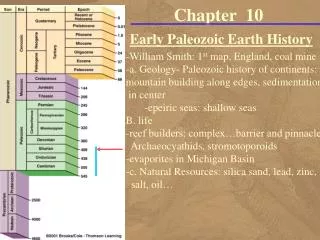
Early Paleozoic Earth History
1.04k likes | 2.13k Vues
Chapter 10. Early Paleozoic Earth History. The First Geologic Map. William Smith, a canal builder, published the first geologic map on August 1, 1815. The First Geologic Map. Five of the six geologic Paleozoic systems Cambrian, Ordovician, Silurian, Devonian, and Carboniferous


Early Paleozoic Earth History
E N D
Presentation Transcript
Chapter 10 Early Paleozoic Earth History
The First Geologic Map • William Smith, • a canal builder, published the first geologic map • on August 1, 1815
The First Geologic Map • Five of the six geologic Paleozoic systems • Cambrian, Ordovician, Silurian, Devonian, and Carboniferous • We use the same basic geologic principles to interpret the geology of the Paleozoic Era
Cratons and Mobile Belts • Pannotia supercontinent began broke apart during the latest Proterozoic • By the beginning of the Paleozoic Era, • six major continents were present • Each continent can be divided • into two major components • a craton • and one or more mobile belts
Continental Architecture • Cratons typically consist of two parts • a shield • and a platform
Platforms • Extending outward from the shields are buried Precambrian rocks • The sediments over the platforms were deposited in widespread shallow seas
Paleozoic North America • Platform
Epeiric Seas • The transgressing and regressing shallow seas • called epeiric seas • common feature of most Paleozoic cratons
Mobile Belts • Mobile belts are elongated areas of mountain building activity • They are located along the margins of continents • where sediments are deposited in the relatively shallow waters of the continental shelf • and the deeper waters at the base of the continental slope • During plate convergence along these margins, • the sediments are deformed • and intruded by magma • creating mountain ranges
Four Mobile Belts • Four mobile belts formed • around the margin • of the North American craton during the Paleozoic • Franklin mobile belt • Cordilleran mobile belt • Ouachita mobile belt • Appalachian mobile belt
Paleozoic North America • Mobil belts
Paleogeographic Maps • Geologists use • paleoclimatic data • paleomagnetic data • paleontologic data • sedimentologic data • stratigraphic data • tectonic data • to construct paleogeographic maps • which are interpretations of the geography of an area for a particular time in the geologic past
Paleozoic paleogeography • The paleogeographic history • of the Paleozoic Era is not as precisely known • as for the Mesozoic and Cenozoic eras • in part because the magnetic anomaly patterns • preserved in the oceanic crust • was subducted during the formation of Pangaea • Paleozoic paleogeographic reconstructions • are therefore based primarily on • structural relationships • climate-sensitive sediments such as red beds, evaporates, and coals • as well as the distribution of plants and animals
Six Major Paleozoic Continents • Baltica - Russia west of the Ural Mountains and the major part of northern Europe • China - a complex area consisting of at least three Paleozoic continents that were not widely separated and are here considered to include China, Indochina, and the Malay Peninsula • Gondwana - Africa, Antarctica, Australia, Florida, India, Madagascar, and parts of the Middle East and southern Europe
Six Major Paleozoic Continents • Kazakhstan - a triangular continent centered on Kazakhstan, but considered by some to be an extension of the Paleozoic Siberian continent • Laurentia - most of present North America, Greenland, northwestern Ireland, and Scotland • and Siberia - Russia east of the Ural Mountains and Asia north of Kazakhstan and south Mongolia
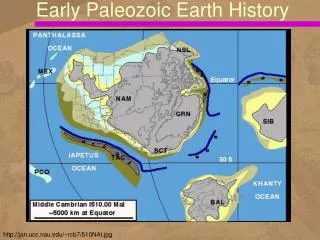
Paleogeography of the World • For the Late Cambrian Period
Paleogeography of the World • For the Late Ordovician Period
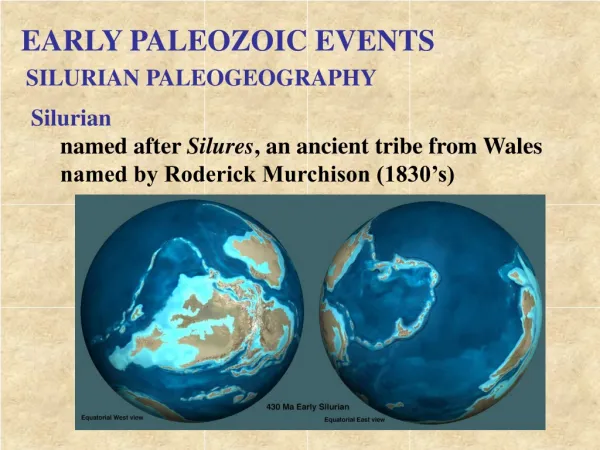
Paleogeography of the World • For the Middle Silurian Period
Early Paleozoic Global History • In contrast to today's global geography, • six major continents • dispersed at low tropical latitudes • polar regions were mostly ice free • By the Late Cambrian, • epeiric seas had covered most areas of • Laurentia, Baltica, Siberia, Kazakhstania, China,
Ordovician and Silurian Periods • Gondwana moved southward during the Ordovician and began to cross the South Pole • as indicated by Upper Ordovician tillites found today in the Sahara Desert • In contrast to Laurentia’s passive margin in the Cambrian, • an active convergent plate boundary formed along its eastern margin during the Ordovician • as indicated by the Late Ordovician Taconic orogeny that occurred in New England
Silurian Period • Baltica moved northwestward relative • to Laurentia and collided with it • to form the larger continent of Laurasia • This collision closed the northern Iapetus Ocean • Siberia and Kazakhstania moved from • a southern equatorial position during the Cambrian • to north temperate latitudes • by the end of the Silurian Period
Early Paleozoic Evolution of North America • The geologic history of the North American craton may be divide into two parts • the first dealing comings and goings of epeiric seas • the second dealing with the mobile belts In 1963, American geologist Laurence Sloss proposed that the sedimentary-rock record of North America could be subdivided into six cratonic sequences
Cratonic Sequences of N. America • That are separated by large-scale uncon-formities shown in brown • White areas represent sequences of rocks Appa-lachian oro-genies Cordilleran orogenies
Cratonic Sequence • A cratonic sequence is • a large-scale lithostratigraphic unit • greater than supergroup • representing a major transgressive-regressive cycle • bounded by craton-wide unconformities • The six unconformities extend across • the various sedimentary basins of the North American craton • and into the mobile belts along the cratonic margin
The Sauk Sequence • Rocks of the Sauk Sequence • during the Late Proterozoic-Early Ordovician • record the first major transgression onto the North American craton • Deposition of marine sediments • during the Late Proterozoic and Early Cambrian • was limited to the passive shelf areas of the • Appalachian and Cordilleran borders of the craton • The craton itself was above sea level • and experiencing extensive weathering and erosion
Cratonic Sequences of N. America • Brown areas = large-scale uncon-formities • White areas = sequences of rocks • Sauk sequence
The Sauk Sequence • Because North America was located • in a tropical climate at this time • but there is no evidence of any terrestrial vegetation, • weathering and erosion of the exposed • Precambrian basement rocks must have proceeded rapidly • During the Middle Cambrian, • the transgressive phase of the Sauk • began with epeiric seas encroaching over the craton
Transcontinental Arch • By the Late Cambrian, • the Sauk Sea had covered most of North America, • leaving above sea level only • a portion of the Canadian Shield • and a few large islands • These islands, • collectively named the Transcontinental Arch, • extended from New Mexico • to Minnesota and the Lake Superior region
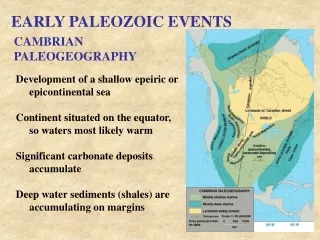
Cambrian Paleogeography of North America • During this time North America straddled the equator • Trans-continental Arch
The Sauk Sediments • The sediments deposited • on both the craton • and along the shelf area of the craton margin • show abundant evidence of shallow-water deposition • The only difference • between the shelf and craton deposits • is that the shelf deposits are thicker
Sauk Carbonates • Many of the carbonates are • bioclastic • composed of fragments of organic remains • contain stromatolites, • or have oolitic textures • contain small, spherical calcium carbonate grains • Such sedimentary structures and textures • indicate shallow-water deposition
A Transgressive Facies Model • Recall that facies are sediments • that represent a particular environment • During a transgression, the coarse (sandstone), • fine (shale) and carbonate (limestone) facies • migrate in a landward direction
Cambrian Transgression • The three formations exposed • along the Bright Angel Trail, Grand Canyon Arizona • Cambrian strata exposed in the Grand Canyon
Transgression • The Tapeats sediments • are clean, well-sorted sands • of the type one would find on a beach today • As the transgression continued into the Middle Cambrian, • muds of the Bright Angle Shale • were deposited over the older Tapeats Sandstone
Time Transgressive Formations • Faunal analysis of the Bright Angel Shale indicates • that it is Early Cambrian in age in California • and Middle Cambrian in age in the Grand Canyon region, • thus illustrating the time-transgres-sive nature of formations and facies younger shale older shale
Cambrian Transgression • Cambrian strata exposed in the Grand Canyon • Observe the time transgressive nature of the three formations • The three formations exposed • along the Bright Angel Trail, Grand Canyon Arizona
Same Facies Relationship • By the end of Sauk time, much of the craton • was submerged beneath a warm, equatorial epeiric sea
Cambrian Facies • showing 3 major Cambrian facies • and the time transgressive nature of the units • The carbonate facies developed progressively • due to submergence of the detrital source areas by the advancing Sauk Sea • Block diagram from the craton interior to the Appalachian mobile belt margin
Upper Cambrian Sandstone • Outcrop of cross-bedded Upper Cambrian sandstone in the Dells area of Wisconsin
Regression and Unconformity • During the Early Ordovician, the Sauk Sea regressed. • The rocks exposed were predominately • limestones and dolostones • that experienced deep and extensive erosion • The resulting craton-wide unconformity • marks the boundary between the Sauk • and Tippecanoe sequences
Ordovician Period • Paleo-geography of North America • showing change in the position of the the equator • The continent • was rotating counter-clockwise
Cratonic Sequences of N. America • brown areas = large-scale uncon-formities • White areas = sequences of rocks • Regression • Tippecanoe sequence
The Tippecanoe Sequence • A transgressing sea deposited the Tippecanoe sequence over most of the craton • Middle Ordovician-Early Devonian • The Tippecanoe basal rock is the St. Peter Sandstone, • an almost pure quartz sandstone • occurs throughout much of the mid-continent • resulted from numerous cycles of weathering • and erosion of Proterozoic and Cambrian sandstones • deposited during the Sauk transgression
Transgression of the Tippecanoe Sea • Resulted in the deposition of • the St. Peter Sandstone • Middle Ordovician • over a large area of the craton
St. Peter Sandstone • Outcrop of St. Peter Sandstone in Governor Dodge State Park, Wisconsin
The Tippecanoe Sequence • The Tippecanoe basal sandstones were followed by widespread carbonate deposition • The limestones were generally the result of deposition • by calcium carbonate-secreting organisms such as • corals, • brachiopods, • stromatoporoids, • and bryozoans
Tippecanoe Reefs and Evaporites • Organic reefs are limestone structures • constructed by living organisms • Reefs appear to have occupied • the same ecological niche in the geological past
Modern Reef Requirements • Present-day reefs • grow between 30 degrees N and S of equator • Reefs require • warm, clear, shallow water of normal salinity for optimal growth
Present-Day Reef Community • with reef-building organisms
Reef Environments • Block diagram of a reef showing the various environments within the reef complex