Time Dependent Properties
This article explores the time-dependent properties of viscosity and creep in polymers when dissolved in solvents. It examines how polymers increase the viscosity of solutions, acting as thickeners in products like shampoos and ice cream. The impact of temperature, molecular size, and intermolecular forces on the viscosity is also discussed. Additionally, the phenomenon of creep—gradual deformation under sustained loads—reveals how materials behave over time under stress. Understanding these properties is crucial in various industrial applications.


Time Dependent Properties
E N D
Presentation Transcript
Time Dependent Properties Viscosity and Creep
Viscosity • Polymers do something when you dissolve them in a solvent: They make the solution viscous. • Viscosity • The internal resistance to flow existing between two liquid layers when they are moved relative to each other. This internal resistance is a result of interaction between liquid molecules in motion.
Viscosity Demonstration And Select ‘Viscosity Measurements’ for Demonstration
Viscosity • You see this all the time: • Polymers are used as thickeners in things like shampoo and even ice cream. • This thickening effect can be used to estimate a polymer's molecular weight. • Temperature can have an effect
Why do polymers make solutions viscous? • Polymers move very slowly, or at least, they move a lot more slowly than do small molecules. • The faster molecules in a liquid move, the more easily the liquid will flow.
Do polymers make the solvent molecules move slowly, too? • Yes. • Ex. Getting stuck behind a huge slow truck on a one lane highway. • And intermolecular forces • If there are any attractive secondary interactions between the polymer and solvent molecules, the small solvent molecules can become bound to the polymer and they move with the polymer.
Viscosity • Bigger polymer molecules make a solution more viscous than small ones do.
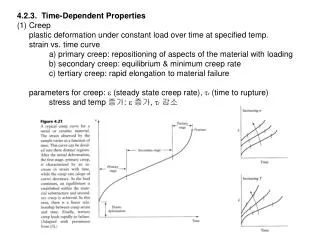
Creep • Creep: the gradual deformation of a material under a load that is less than the yield strength of the material • Significant deformations with small loads but over long periods of time
Creep • The amount of creep is strongly dependent upon the amount of the load, the time the load is applied and the temperature of the material. • Increases in any of these parameters will cause the creep deformation to be greater