Understanding the Life Cycle of Neurotransmitters: From Synthesis to Action
This overview delves into the complex life cycle of conventional neurotransmitters. Starting from their biosynthesis in the cell body, neurotransmitters are transported down the axon to the terminal, where they are stored in synaptic vesicles. Upon an action potential, calcium influx triggers the release of these neurotransmitters into the synapse through exocytosis. They act on ionotropic or metabotropic receptors to produce excitation or inhibition. The process also includes mechanisms of inactivation such as breakdown and reuptake, which maintain synaptic balance.

Understanding the Life Cycle of Neurotransmitters: From Synthesis to Action
E N D
Presentation Transcript
The Life Cycle of a Conventional NT • Biosynthesis & Storage • Release • Receptor Action • Inactivation
Transmitter Enzyme(s) Biosynthesis Precursor(s)
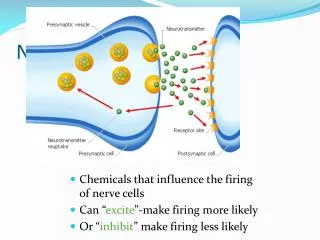
Storage • Synaptic vesicles made by Golgi apparatus in cell body • Precursors, enzymes, and vesicles are transported from cell body down axon to terminal • At terminal, NTs are synthesized and packaged into vesicles • Filled vesicles dock onto proteins in terminal
Release • Action potential opens channels for Ca++ to enter terminal membrane • Vesicles to undock and move to membrane • Vesicles fuse with membrane and empty transmitter into synapse (exocytosis)
Receptor Action • Ionotropic • Opens ion channel in receptor itself • Ions produce either excitation or inhibition • Fast action • Metabotropic • Sets off cascade of chemical events • Can lead to ion channel opening on another protein • Can lead to other, long-term changes • Slower action
Transmitter Enzyme(s) Breakdown Products Inactivation • Destruction • Reuptake
More on Receptors • Gating • Ligand (activated by NT or drug) • Voltage (activated by depolarization) • Location • Postsynaptic • Presynaptic • Autoreceptor • Heteroreceptor
Presynaptic Autoreceptor =
Presynaptic Heteroreceptors
Some Receptor and Other Changes • Receptor number (up/down-regulation) • Receptor affinity (low/high) • Reuptake transporter number/affinity • Enzyme levels • Transmitter synthesis • Axon growth • Dendrite growth • Etcetera
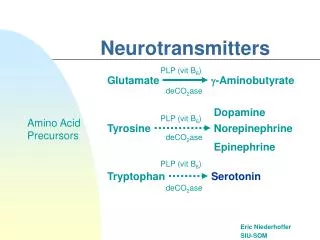
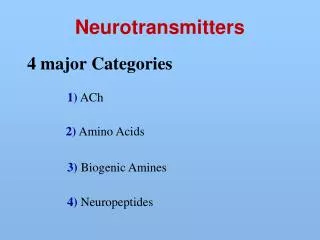
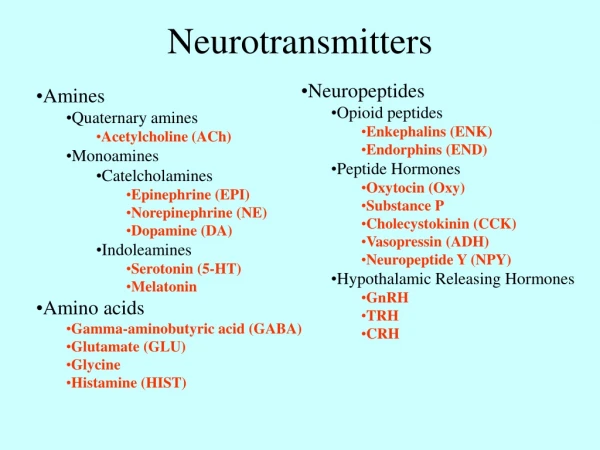
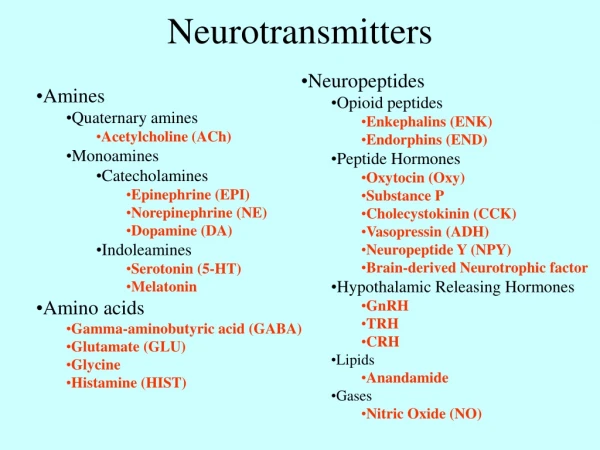
Hierarchy of NTs of Interest Amino Acids Glutamate (Glu) GABA Biogenic Amines Quaternary Amines Acetylcholine (Ach) Monoamines Catecholamines Dopamine (DA) Norepinephrine (NE) Indolamines Serotonin (5-HT) Neuropeptides Opioid Peptides Enkephalins Endorphins Dynorphins (Others: lipids, nucleosides, soluble gases)
Amino Acid NTs • High concentration in brain (micromolar) • Small vesicles • Point-to-point communication • Mostly cortex-to-cortex • Sensory-motor functions • Consistently excitatory or inhibitory • Mainly ionotropic receptors • Fast acting, short duration (1-5 ms) • Examples: Glutamate, Aspartate, GABA, Glycine
Biogenic Amines • Medium concentration in brain (nanomolar) • Small vesicles • Single-source divergent projections • Mainly midbrain to cortex • Modulatory functions • Excitatory or inhibitory by receptor • More metabotropic receptors than ionotropic, but plenty of both • Slow acting, long duration (10-1000 ms) • Examples: Acetylcholine, Epinephrine, Norepinephrine, Dopamine, Serotonin
Neuropeptides • Low concentration in brain (picomolar) • Large vesicles • Packaged in vesicles before transport to terminal • Co-localized with other transmitters • Interneuronal • Modulatory functions • Mostly inhibitory • Virtually all metabotropic • Slow acting, long duration (10-1000 ms) • Examples: Enkephalins, Endorphins, Oxytocin, Vasopressin
Modulatory Functions • State-dependent effects • Regulate influence of extrinsic vs. intrinsic activity • Synchronization of areas/functions • Motivational/emotional recruitment of mental resources