Download
1 / 7
80 likes | 278 Vues
The nervous system performs crucial functions, including receiving information from both internal and external environments and directing the body's responses. It plays a significant role in maintaining homeostasis, ensuring stable internal conditions. Key concepts include stimuli, responses, and neuron types: sensory neurons gather information, interneurons relay signals, and motor neurons trigger muscle contractions. Communication occurs through nerve impulses, with signals traveling unidirectionally from dendrites to axons, across synapses. Explore how these components work together to facilitate complex bodily functions.

E N D
The Nervous System
Functions of the Nervous System • Receives information about what is happening both inside and outside your body • Directs the way in which your body responds to the information it receives • Lastly, your nervous system helps to maintain stable internal condition which is homeostasis.
Stimulus – a change or signal in the environment that can make an organism react Response – how the body reacts to the stimulus
Neuron – Cell that carries information through the nervous system Nerve impulse – Message that a neuron carries
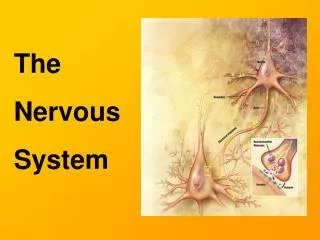
Direction of Impulse (One Way ONLY) Dendrite – Carries impulses TOWARD the Cell Body. Axon – Carries information AWAY from the Cell Body.
Types of Neurons: • Sensory Neuron – picks up information from internal / external environment and converts the information to an impulse • Interneuron – neuron that carries information from one neuron to another neuron • Motor Neuron – sends an impulse to a muscle causing it to contract
Synapse – tiny space between the axon tip and the next structure