

Attachment
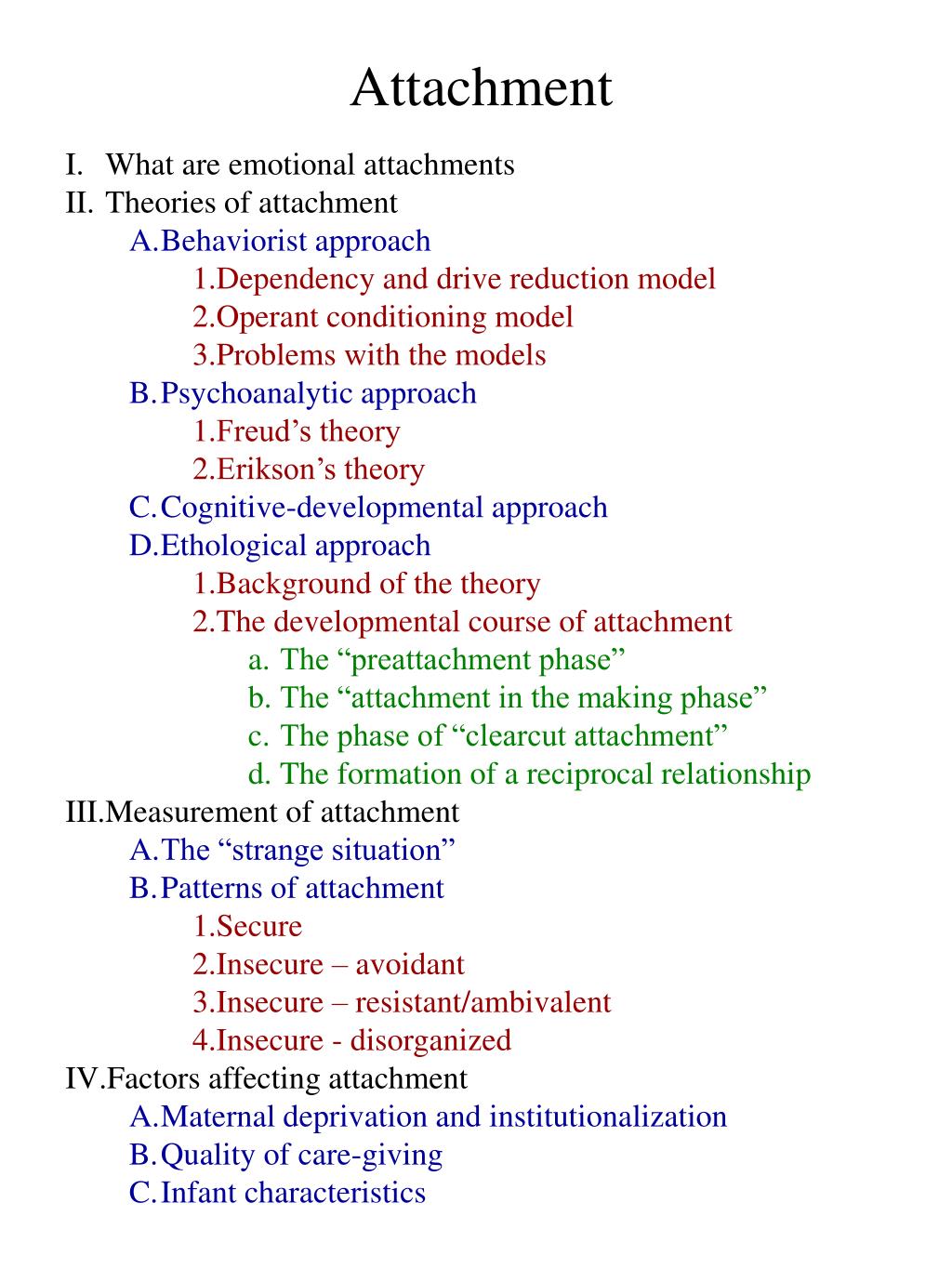
Attachment. What are emotional attachments Theories of attachment Behaviorist approach Dependency and drive reduction model Operant conditioning model Problems with the models Psychoanalytic approach Freud’s theory Erikson’s theory Cognitive-developmental approach Ethological approach
Attachment
E N D
Presentation Transcript
Attachment • What are emotional attachments • Theories of attachment • Behaviorist approach • Dependency and drive reduction model • Operant conditioning model • Problems with the models • Psychoanalytic approach • Freud’s theory • Erikson’s theory • Cognitive-developmental approach • Ethological approach • Background of the theory • The developmental course of attachment • The “preattachment phase” • The “attachment in the making phase” • The phase of “clearcut attachment” • The formation of a reciprocal relationship • Measurement of attachment • The “strange situation” • Patterns of attachment • Secure • Insecure – avoidant • Insecure – resistant/ambivalent • Insecure - disorganized • Factors affecting attachment • Maternal deprivation and institutionalization • Quality of care-giving • Infant characteristics
Behaviorist Approach to Attachment • The importance of feeding and drive reduction • Elicits positive responses • Mothers provide infants with additional comforts, such as warmth, vocalizations • All occur in single setting • Mom becomes source of reinforcement
Behaviorist Approach to Attachment • The importance of feeding and drive reduction • Elicits positive responses • Mothers provide infants with additional comforts, such as warmth, vocalizations • All occur in single setting • Mom becomes source of reinforcement • Operant Conditioning model • Infants look, smile, and seek proximity because mom reciprocates with smiles, hugs • The greater number of behaviors that get reinforced by particular person, the more one is attached to that person
Psychoanalytic Approach to Attachment • Freudian approach • Similar to drive reduction • Become attached to person who satisfies basic biological drives (typically Mom) • Relationship with Mom then prototype for romantic relationships throughout life • Erikson’s approach • 1st developmental stage: birth – 1 yr: Trust vs. mistrust • Children become attached to people who minister to needs • Importance of mother’s overall responsiveness
Cognitive-DevelopmentalApproach to Attachment • Little to say about which people to whom one becomes attached • Suggests that attachment depends, in part, on level of cognitive development • Must be able to discriminate familiar persons from strangers • Must recognize that familiar persons have permanence – object permanence abilities, as discussed earlier • Thus, timing of attachment related to timing of development of cognitive ability
Ethological Approach to Attachment • Central feature of theory • Babies born with in-born set of behaviors • Behaviors elicit parent care, thus increase change of survival • The developmental course of attachment • The preattachment phase • Behavior a matter of genetically determined reflexive responses with survival value • Promote physical contact • Attachment in the making • Orient and respond with preference towards mom • No specific attachment yet • The phase of clearcut attachment • Shows separation anxiety • Mom as a “safe haven” • Formation of a reciprocal relationship • Decrease in separation anxiety
Patterns of Attachment • Insecure – Avoidant • Little distress at separation • Avoids mother during reunion • About 20% of North-American infants • Securely Attached • Distressed during separation • Seeks out mother during reunion • About 65% of North-American infants • Insecure – Ambivalent/Resistance • Distressed throughout, and during separation • Reunion a mixture of relief and anger • About 10% of North-American infants • Insecure – Ambivalent/Resistance • Combination of avoidant and ambivalent/resistant • Confusion over whether to approach or avoid • During reunion may act dazed or freeze • About 5 - 10% of North-American infants