
SlideServe
Menu
Préférences
© SlideServe · v2026

SAMUEL MORSE

lotus avatar
7 diapositives · 1.5K Views · Jan 28, 2012

SAMUEL MORSE. BY ERIK BROPHY. Samuel Morse: Samuel Finley Breeze Morse was born in Charlestown, Mass. on 27th April 1791. He was not a scientist - he was a professional artist.
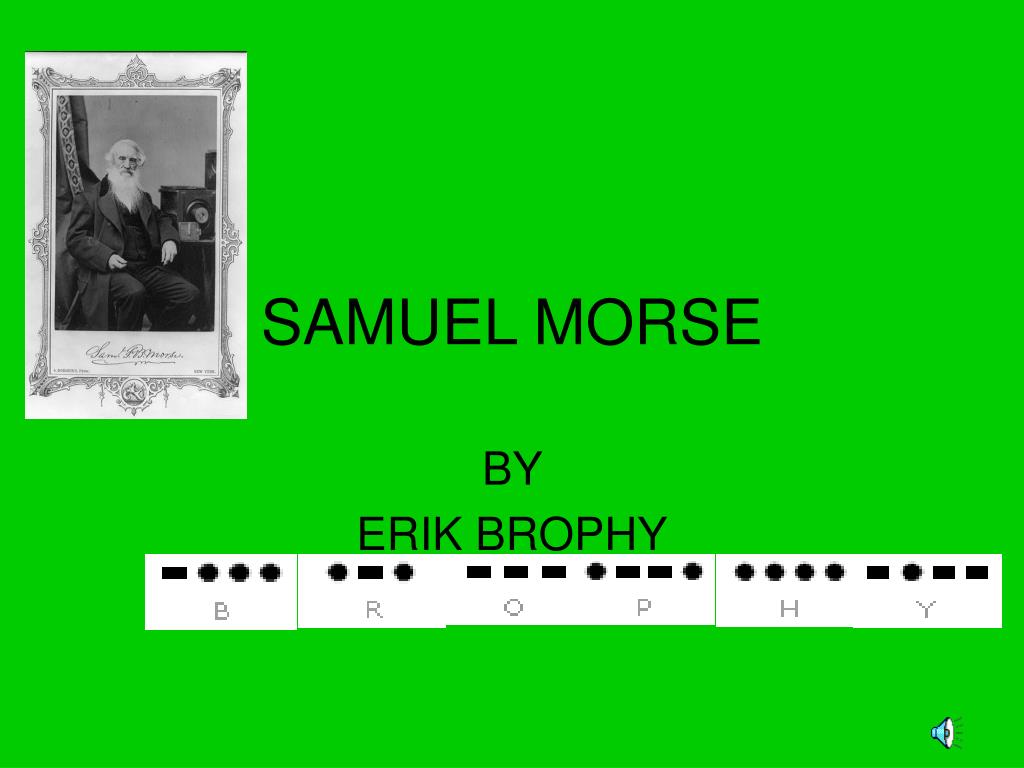
SAMUEL MORSE - slide 1
01 / 7SAMUEL MORSE
1 / 17

Télécharger la présentation

SAMUEL MORSE
Une image / un lien ci-dessous est fourni (tel quel) pour télécharger la présentation

Politique de téléchargement : le contenu du site vous est fourni TEL QUEL pour votre information et votre usage personnel ; il ne peut être vendu, concédé sous licence ni partagé sur d’autres sites sans l’accord de son auteur.Le contenu vous est fourni TEL QUEL, pour votre information et votre usage personnel uniquement. Téléchargez la présentation en cliquant sur ce lien. Lors du téléchargement, si vous ne parvenez pas à télécharger une présentation, l’éditeur a peut-être supprimé le fichier de son serveur.Pendant le téléchargement, si vous ne parvenez pas à obtenir une présentation, le fichier a peut-être été supprimé par l’éditeur.

F I N

Plus de contenu associé

Transcription de la présentation
  1. SAMUEL MORSE BY ERIK BROPHY

  2. Samuel Morse: Samuel Finley Breeze Morse was born in Charlestown, Mass. on 27th April 1791. • He was not a scientist - he was a professional artist. • Educated at Phillip’s Academy at Andover, he graduated from Yale in 1810 and he lived in England from 1811 to 1815, exhibiting at the Royal Academy in 1813. • He spent the next ten years as an itinerant artist with a particular interest in portraiture. • He returned to America in 1832 having been appointed Professor of Painting and Sculpture at the University of the City of New York.

  3. It was on this homeward voyage that he overheard a shipboard discussion on electromagnets. This was the seed out of which the electric telegraph grew. Morse is remembered for his Code, still used, and less for the invention that enabled it to be used, probably since landline telegraphy eventually gave way to wireless telegraphy.

  4. Morse is remembered for his Code, still used, and less for the invention that enabled it to be used, probably since landline telegraphy eventually gave way to wireless telegraphy

  5. Telegraph stations in the United States, the Canadas & Nova Scotia, 1853 This map reveals the status of the telegraph network as it existed in the U.S. in 1853, only nine years after the first message. By this time, only one state east of the Mississippi, Florida, was not connected by telegraph. The legend on the left offers the list of message rates from Pittsburgh. By 1861, telegraph lines connected the American continent; by 1866, the transatlantic cable connected America and Europe.

  6. Samuel  Morse Telegraph ReceiverUsed to receive the message, "What hath God wrought"during the demonstration to Congress in 1844.