Exploring the Parthenon Replica in Nashville: Area Calculations of Its Rooms
The Parthenon replica in Nashville, Tennessee, constructed in 1897, reflects ancient Greek architecture. This educational guide presents methods for calculating the total area of two adjacent rooms within the replica. By utilizing various mathematical approaches, you can find the combined area effortlessly. Method 1 involves calculating each room's area followed by summation, while Method 2 simplifies the process by multiplying the total length by a common width. Discover how these techniques align with architectural studies and practical applications.

Exploring the Parthenon Replica in Nashville: Area Calculations of Its Rooms
E N D
Presentation Transcript
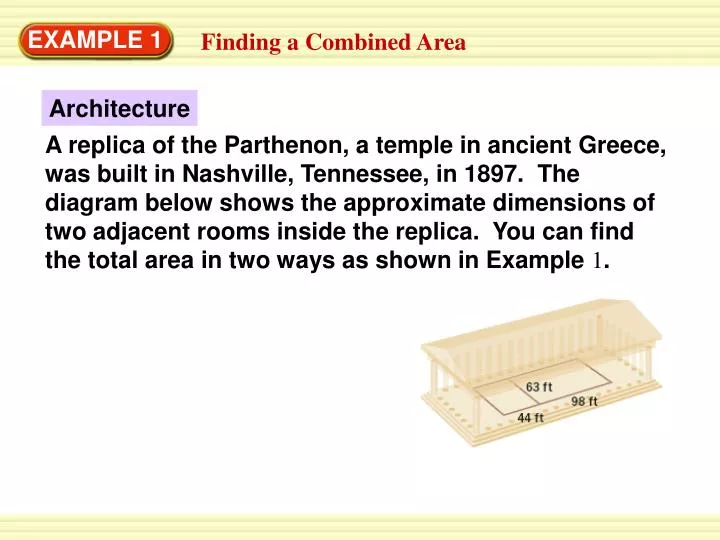
A replica of the Parthenon, a temple in ancient Greece, was built in Nashville, Tennessee, in 1897. The diagram below shows the approximate dimensions of two adjacent rooms inside the replica. You can find the total area in two ways as shown in Example 1. EXAMPLE 1 Finding a Combined Area Architecture
Two methods can be used to find the total area of the two rooms. EXAMPLE 1 Finding a Combined Area METHOD 1 Find the area of each room, and then find the total area. Area = 63(44) + 63(98) = 2772 + 6174 = 8946 square feet
(142) = 63 ANSWER The total area of the two rooms is 8946 square feet. EXAMPLE 1 Finding a Combined Area METHOD 2 Find the total length, and then multiply by the common width. Area = 63(44 + 98) = 8946 square feet
a. –5(x + 10) b. 3[1 – 20 + (–5)] EXAMPLE 2 Using the Distributive Property = –5x + (–5)(10) Distributive property = –5x + (–50) Multiply. = –5x – 50 Simplify. = 3(1) – 3(20) + 3(–5) Distributive property = 3 – 60 + (–15) Multiply. = 3 + (–60) + (–15) Add the opposite of 60. = –72 Add.
1. 10 ( 12 + 22 ) = ( 34 ) = 10 340 ft2 = for Examples 1 and 2 GUIDED PRACTICE Use the distributive property to find the area of the figure. Find the total length, and then multiply with common width. Area
2. 14 ( 3 + 9 ) = ( 12 ) = 14 168 m2 = for Examples 1 and 2 GUIDED PRACTICE Use the distributive property to find the area of the figure. Find the total length, and then multiply with common width. Area
–2(5 + 12) 3. for Examples 1 and 2 GUIDED PRACTICE Use the distributive property to evaluate or write an equivalent expression. = –2(5) + (–2)(12) –2(5 + 12) Distributive property = –10 + (–24) Multiply. = –34 Add.
–4(–7 – 10) 4. for Examples 1 and 2 GUIDED PRACTICE Use the distributive property to evaluate or write an equivalent expression. = –4(–7) – (–4)(–10) –4(–7 – 10) Distributive property = 28 + 40 Multiply. = 68 Add.
2(w – 8) 5. for Examples 1 and 2 GUIDED PRACTICE Use the distributive property to evaluate or write an equivalent expression. = 2w – (2)(8) 2(w – 8) Distributive property = 2w – (16) Multiply. = 2w – 16 Simplify.
–8(z + 25) 6. = –8z + (–200) for Examples 1 and 2 GUIDED PRACTICE Use the distributive property to evaluate or write an equivalent expression. = –8z + (–8)(25) –8(z + 25) Distributive property Multiply. = –8z – 200 Simplify.