Analyzing Union and Confederate Advantages and Strategies in the Civil War
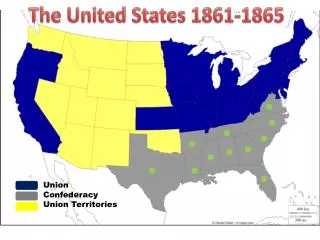
This examination investigates the strengths and weaknesses of both the Union and Confederacy at the onset of the Civil War. The Union initially held advantages, including a larger population of 22 million and a robust railroad system, while the Confederacy faced challenges with a smaller population of 9 million and inadequate rail infrastructure. However, the Confederacy had its own strengths, such as familiar territory and a defensive strategy rooted in fighting for their homeland. This analysis also considers both sides' strategies for achieving victory during the conflict.

Analyzing Union and Confederate Advantages and Strategies in the Civil War
E N D
Presentation Transcript
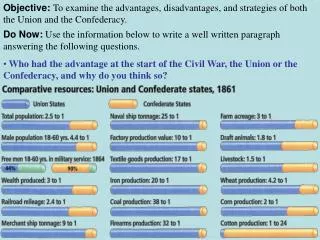
Objective:To examine the advantages, disadvantages, and strategies of both the Union and the Confederacy. • Do Now: Use the information below to write a well written paragraph answering the following questions. • Who had the advantage at the start of the Civil War, the Union or the Confederacy, and why do you think so?
Union Advantage • large population of 22 million Confederate Disadvantage • small population of 9 million, of which 1/3 were slaves
Union Advantage • excellent railroad system Confederate Disadvantage • poor railroad system
Confederate Advantages Union Disadvantages • The South was a huge area to conquer. • fought a defensive war at home • defending their homeland • The North invaded unfamiliar territory.
Strategies for Victory Union plans: · blockade Southern ports · seize control of the Mississippi River · capture the Confederate capital of Richmond, Virginia
Confederate plans: · To stay at home and fight a defensive war. · The South believed that the North would quickly tire of fighting and give up. · The South counted on European money and supplies. What were the major causes of the Civil War? Let’s review. (3:54)