Access Modes and Patrols During Hardware Commissioning: Strategies and Safety Measures
This document outlines the access modes and patrol strategies implemented during Hardware Commissioning (HC) periods. It discusses the rationale for these methods, emphasizing the goals of safety and operational efficiency. It addresses open points arising from recent discussions, inviting further comments, critiques, and suggestions from stakeholders. The content is attributed to contributors including M. Solfaroli and others, with acknowledgment of specific risks like cryogenics and electrical hazards during various phases. Striking a balance between safety and operational needs, the document explores patrol requirements under different conditions.

Access Modes and Patrols During Hardware Commissioning: Strategies and Safety Measures
E N D
Presentation Transcript
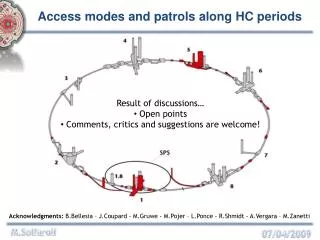
Access modes and patrols along HC periods • Result of discussions… • Open points • Comments, critics and suggestions are welcome! M.Solfaroli Acknowledgments:B.Bellesia – J.Coupard - M.Gruwe - M.Pojer – L.Ponce - R.Shmidt - A.Vergara – M.Zanetti 07/04/2009
Access modes and patrols along HC periods Why did we decide to use the access system during Hardware Commissioning? • To commission it • To HELP on keeping safety M.Solfaroli
Access modes and patrols along HC periods ElQA @ warm ADI M.Solfaroli
Access modes and patrols along HC periods M.Solfaroli
ElQA @ warm • Signalization in the UAs where a danger could be created • only in case of a short to ground throughout instrumentation • (no risk if no work) • No strict control necessary because of presence of involved • people in sensitive points (i.e. DFBs) – no patrol! • Close of the external envelope • Setting Restricted Mode on the access point/s • Special work could be allowed during the Low Voltage phase M.Solfaroli
Access modes and patrols along HC periods ElQA @ warm BTW ElQA & ElQA M.Solfaroli
BTW ElQA and ElQA • The second cool-down is not consider dangerous • for people (this argument doesn’t apply to sector 34) • Power converters are still locked • 2 Possibilities: • Maintain the Restricted Mode for keeping the • control of the ongoing Hardware Commissioning • Passing in General Mode with restricted list (as done for • S34) updated via ADI if manpower cannot cope with accesses M.Solfaroli
Access modes and patrols along HC periods ElQA @ warm BTW ElQA & ElQA ElQA @ cold M.Solfaroli
ElQA @ cold • Signalization in the UAs where a danger could be created • only in case of a short to ground throughout instrumentation • (no risk if no work) • No strict control necessary because of presence of involved • people in sensitive points (i.e. DFBs) – no patrol! • Close of the external envelope • Setting Restricted Mode on the access point/s • Special work could be allowed during the Low Voltage phase M.Solfaroli
Access modes and patrols along HC periods ElQA @ warm BTW ElQA & ElQA ElQA @ cold Phase I M.Solfaroli
Access modes and patrols along HC periods M.Solfaroli
Phase I • In the UAs risks only if working on the Power Converters or • on the QPS racks. Surfaces access points in General Mode • In the tunnel: • Cryogenic risks have been excluded (low energy stored) • Only electrical risks • Access system in Restricted Mode • Patrol vs no patrol?? M.Solfaroli
Phase I In case of a door forced, control of the sector would be lost but, given that there are no cryogenic risks (while in phase I), is a patrol really necessary? People entering and working are doing so without Avis D’Intervention AND/OR forcing doors!! M.Solfaroli
Access modes and patrols along HC periods ElQA @ warm BTW ElQA & ElQA ElQA @ cold Phase I Phase II M.Solfaroli
Phase II • High cryogenic risks • High electrical risks • Both tunnel and UAs (experiments?) in • Closed Mode and patrolled M.Solfaroli
General points M.Solfaroli
General points ? M.Solfaroli